The Soul’s Echo Chamber: How Collaborative Learning Resonates in the Hollows of a Child’s Heart
The first time I witnessed the quiet magic of a classroom humming with collaboration, I felt as though I had stepped into an echo chamber of souls. Not the kind that distorts sound into chaos, but one that amplifies the faintest whispers of understanding until they swell into a chorus of shared discovery. It was a moment that lingered in the air like the afterglow of a struck match—brief, yet impossible to forget. There, in that space, learning was not a solitary climb up a ladder of facts but a dance, a slow and deliberate waltz where every misstep was met with a steadying hand and every triumph celebrated with a collective breath.
The Alchemy of Shared Silence
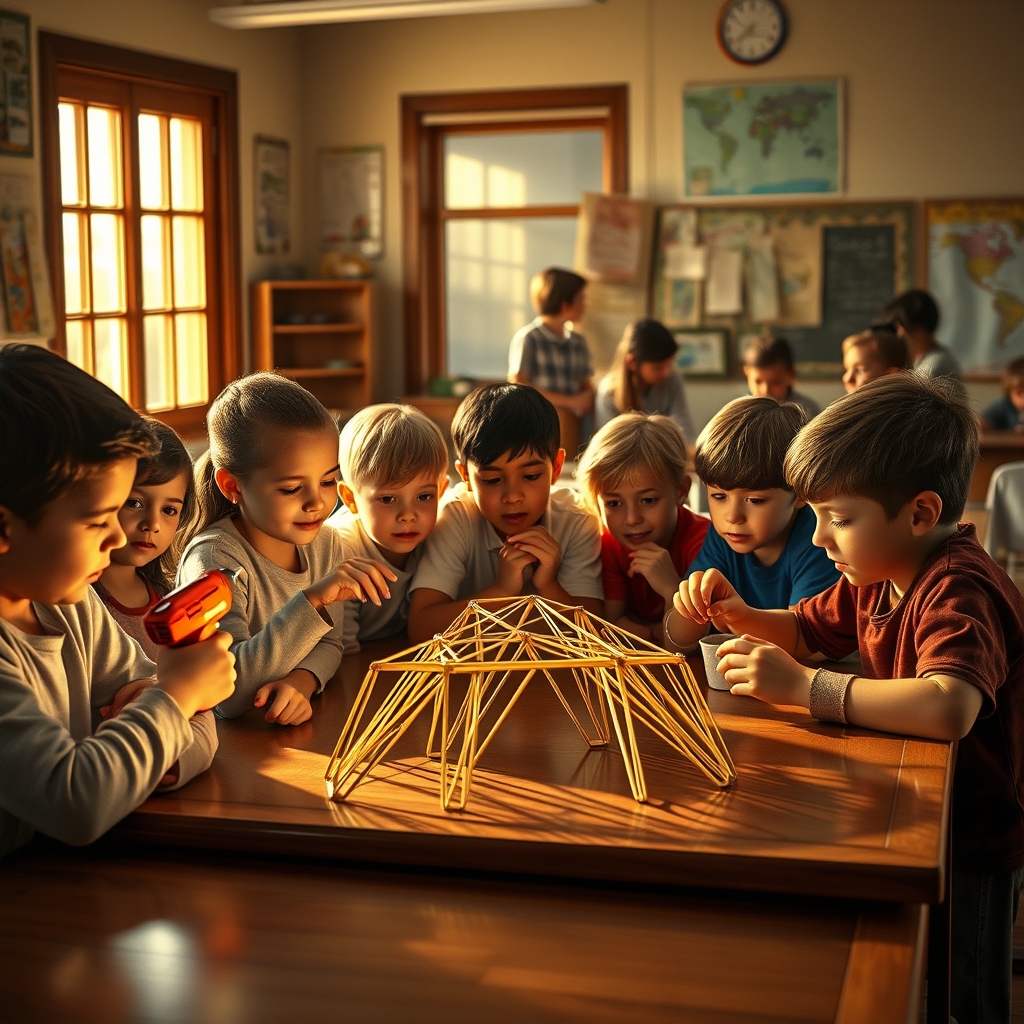
I remember the day the children in Mrs. Elara’s third-grade class were tasked with building a bridge from popsicle sticks and glue. Not just any bridge—one that could hold the weight of their unspoken dreams, their fears, their tiny, trembling ambitions. The room was alive with the rustle of sticks and the sticky sigh of glue guns, but what struck me most was the silence. Not the heavy, suffocating kind, but the sort that hums with possibility, where every child’s focus is a thread weaving into the tapestry of the group’s effort. When one child’s bridge collapsed under the weight of a single eraser, another was there, not with pity, but with a question: “What if we try it this way?” The eraser was placed again, and this time, the bridge held. The room did not erupt in cheers; it exhaled, as if the collective breath of the class had been holding itself in anticipation.
The Geography of Listening
Collaborative learning is not merely about working together; it is about listening in a way that transforms the act into a sacred ritual. I recall a high school literature circle where the students were dissecting a poem about loss. One boy, usually quiet, spoke up, his voice barely above a whisper. He didn’t offer an analysis of metaphor or structure; instead, he shared how the poem reminded him of his grandfather’s hands, gnarled and trembling, the last time he saw him. The room stilled. No one rushed to fill the silence with their own interpretations. They let his words settle, like dust motes in sunlight, before another student picked up the thread, weaving his own memory into the fabric of the discussion. In that moment, the poem was no longer a text to be studied; it was a living thing, pulsing with the heartbeats of those who dared to listen.
The Architecture of Belonging
There is an invisible architecture to collaborative spaces, one built not with bricks and mortar but with the fragile, resilient bonds of trust. I saw this in a middle school science project where students were divided into teams to design a sustainable city. One team struggled—personalities clashed, ideas were dismissed, and frustration hung thick in the air. Then, a girl named Mira, who had been silent for days, spoke up. She didn’t propose a grand solution; she simply asked, “What if we start by listening to why everyone’s idea matters?” The shift was subtle but profound. The team began to build not just a city, but a shared language of respect. By the end of the project, their model wasn’t the most polished, but it was the one that carried the fingerprints of every member, each contribution a testament to the unspoken covenant they had forged.
The Weight of Small Hands
In the early years of schooling, collaboration often begins with the simplest of gestures: a child handing a crayon to a peer, or another offering to hold the door. These moments are easy to overlook, dismissed as mere politeness. But they are the foundation upon which the grander structures of shared learning are built. I watched a group of kindergarteners attempt to solve a puzzle together. One child, frustrated, began to cry. Another, without a word, slid the puzzle piece she was holding toward him. He took it, fit it into place, and the puzzle was complete. The teacher didn’t intervene; she didn’t need to. The children had already learned the most important lesson: that their hands, no matter how small, could lift another up.
The Hollows Where Echoes Live
There is a peculiar beauty in the hollows of a child’s heart—those quiet, unseen spaces where the echoes of shared experiences resonate long after the moment has passed. I think of a teenager I once mentored, a boy named Elias, who struggled with self-doubt. He had been part of a collaborative history project where his team had to present on a forgotten figure from the past. Elias, usually reticent, had chosen to speak about a poet whose words had been erased by time. When he stood before the class, his voice trembled, but his teammates stood beside him, their presence a silent vow of support. Afterward, he told me, “I didn’t feel like I was alone up there. It was like they were holding my voice with me.” That echo—the knowledge that he was not alone—stayed with him, a quiet companion in the years that followed.
The Unseen Currents of Collaboration
Collaborative learning is not a method; it is a current, one that carries children through the rapids of doubt and the still waters of confidence. It is the understanding that no one is an island, that even the most solitary of learners is part of a vast, interconnected archipelago. I have seen this current at work in a rural classroom where students, separated by miles of dirt roads, came together via video call to write a play. Their voices, though disembodied, wove a story that was richer for its diversity, each line a thread in a tapestry that none of them could have created alone. The play was performed in their respective communities, and for one night, the distance between them dissolved into the shared magic of creation.
There is a moment in every collaborative endeavor when the illusion of separateness falls away, and what remains is the raw, beautiful truth that we are all, in some way, echoes of one another. It is in these moments that the hollows of a child’s heart are filled not with answers, but with something far more enduring: the knowledge that their voice, no matter how small, is part of a greater song. And perhaps that is the most profound lesson of all—that learning is not a solitary journey, but a symphony, where every note, every pause, every dissonant chord has its place in the music of understanding.