The Soul’s Crucible: How the Alchemy of Adaptive Education Transforms the Lead of Uncertainty into the Gold of Discovery
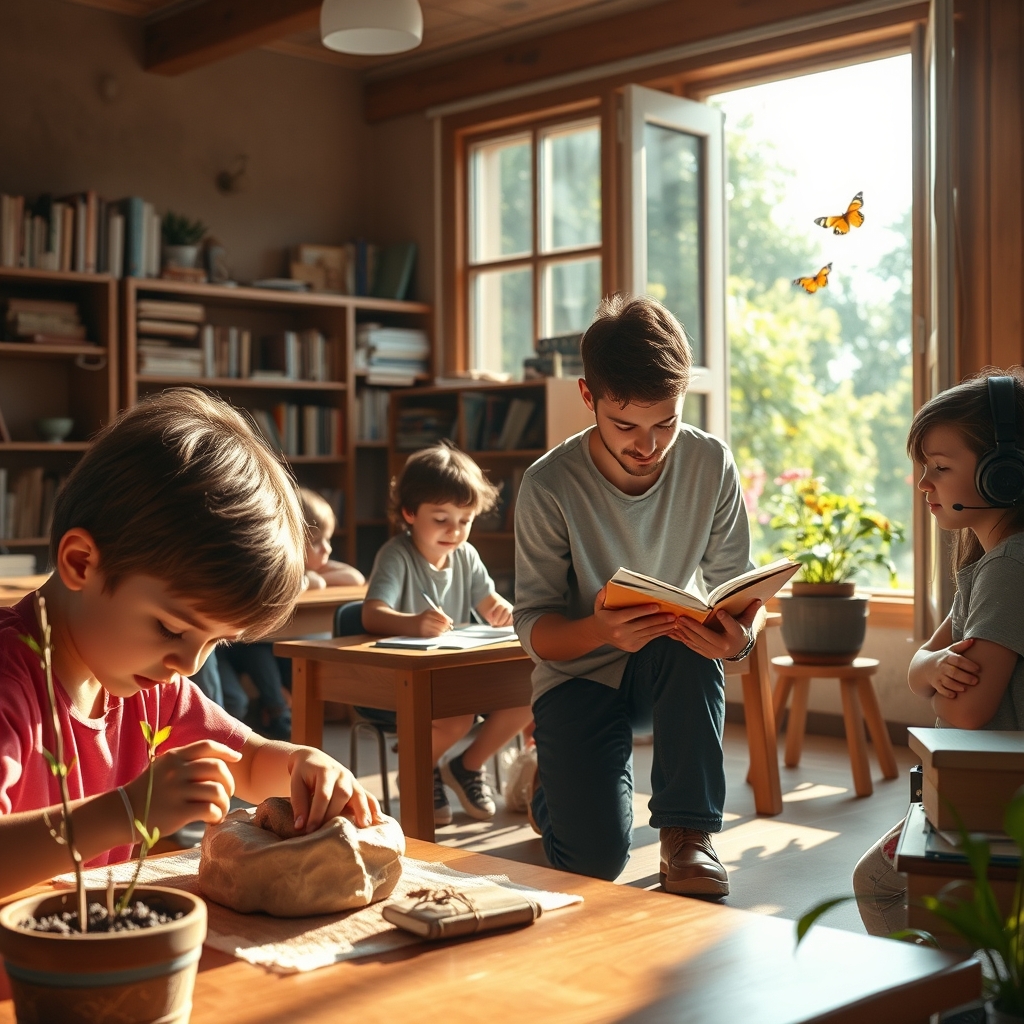
The first time I stepped into a classroom that breathed with the rhythm of its students, I felt the ground shift beneath my feet. It was not the polished floors or the gleaming whiteboards that unsettled me, but the quiet hum of possibility—an energy that pulsed through the air like the first notes of a symphony yet to be composed. This was not education as I had known it; this was a living, evolving entity, shaped by the hands of those who inhabited it. Here, the curriculum did not dictate the learner; the learner, in turn, reshaped the curriculum, bending it like light through a prism to reveal the spectrum of their own potential.
The Unseen Architecture of Adaptive Learning
Adaptive education is often mistaken for a mere tool, a digital algorithm that adjusts difficulty levels or tailors content to a student’s pace. But to reduce it to such mechanics is to overlook its soul—the way it mirrors the organic, unpredictable nature of growth itself. It is the art of listening, not just to the answers a child gives, but to the questions they dare not ask. It is the patience of a gardener who knows that some seeds take longer to sprout, and that the soil must be tended differently for each one.
I remember a student, let’s call him Eli, who carried the weight of frustration like a second skin. Traditional classrooms had taught him to see his struggles as failures, his pauses as deficiencies. But in this adaptive space, his silence was not met with impatience. Instead, the room expanded around him, offering multiple pathways to the same destination. When he faltered, the curriculum did not push him forward; it wrapped around him like a scaffold, holding him gently until he found his footing. And then, one day, he did not just answer a question—he asked one. Not because he was prompted, but because the environment had finally made space for his voice to exist without fear.
The Alchemy of Struggle and Support
There is a delicate balance in adaptive education, a dance between challenge and comfort that must be choreographed with precision. Too much support, and the learner never discovers their own strength; too little, and they drown in the current of their own doubt. The magic lies in knowing when to step in and when to step back, when to offer a hand and when to let the struggle become the teacher.
This is where the soul of adaptive education reveals itself—not in the data it collects, but in the stories it helps unfold. It is in the moment a child realizes that their mistakes are not dead ends, but detours leading to unexpected vistas. It is in the quiet triumph of a student who, after months of stumbling, finally pieces together a concept not because it was explained to them, but because they were given the time and space to discover it for themselves. These are the moments that forge resilience, the kind that cannot be measured by tests but is etched into the very fabric of a person’s being.
The Living Curriculum: A Dialogue, Not a Dictation
What does it mean for a curriculum to be alive? It means that it does not exist in isolation, as a static set of objectives to be checked off a list. Instead, it breathes, it responds, it evolves in conversation with the learner. A living curriculum is not a map handed to a traveler; it is a compass that points them toward their own north, allowing them to chart their course through uncharted territories.
In this kind of environment, the teacher’s role transforms. No longer the sole keeper of knowledge, they become a co-traveler, a guide who walks alongside the student, offering wisdom when needed but never imposing it. The classroom becomes a laboratory of inquiry, where questions are more valuable than answers, and curiosity is the currency of learning. Here, a student’s fascination with the migration patterns of monarch butterflies might lead to a project that weaves together biology, geography, and creative writing. The curriculum does not resist this detour; it embraces it, recognizing that the most profound learning often happens when we follow the threads of our own wonder.
The Echoes of Empathy in Responsive Design
At the heart of adaptive education is empathy—the ability to see the world through another’s eyes, to understand that the path to knowledge is not a straight line but a winding road, unique to each traveler. This empathy is what allows a responsive curriculum to take shape. It is the quiet voice that whispers, “Not yet, but soon,” when a child struggles. It is the patience to sit with discomfort, knowing that growth often lives in the spaces between what is known and what is yet to be discovered.
I have seen this empathy in action in the most unexpected places. In a classroom where a student with dyslexia was given the freedom to express their understanding through art rather than text. In a school where a child on the autism spectrum was not forced to conform to neurotypical expectations but was instead provided with tools to navigate the world in their own way. These are not concessions; they are affirmations. They say, “Your way of learning is not a deviation from the norm; it is a valid and valuable part of the human experience.”
The Gold Forged in the Crucible
Adaptive education is not a panacea. It does not erase the challenges of learning or the complexities of human growth. But what it does do is something far more profound: it reframes struggle as a necessary part of the journey, not a sign of failure. It teaches students that their minds are not fixed entities but malleable landscapes, capable of change and growth. It reminds them—and us—that the purpose of education is not to fill a vessel but to ignite a fire.
When I think back to Eli, I do not remember the day he finally answered a question correctly. I remember the day he asked one. It was not a grand question, not one that would change the world. But it was his. And in that moment, I understood the true alchemy of adaptive education: it does not turn lead into gold. It reveals the gold that was there all along, hidden beneath the layers of doubt and uncertainty, waiting for the right conditions to shine.
The classroom that breathes, that listens, that adapts—it is not just a place of learning. It is a crucible, where the raw materials of human potential are heated, hammered, and shaped into something enduring. And in that transformation, we do not just teach students; we remind them of what they have always been capable of becoming.