The Soul’s Crucible: How the Fire of Real-World Alchemy Transforms the Lead of Routine into the Gold of Discovery

There is a quiet magic in the way a child’s eyes widen when the world suddenly makes sense—not through the sterile pages of a textbook, but through the grit of their own hands, the murmur of collaboration, the unexpected spark of a question that refuses to be ignored. This is the alchemy of real-world learning, where the leaden weight of routine dissolves into the molten gold of discovery. It is not a process of instruction, but of revelation, where every stumble is a lesson, every failure a stepping stone, and every success a whisper of what might yet be possible.
The Unseen Forge of Experience
Imagine a classroom where the walls do not confine but expand, where the air hums with the energy of hands-on creation rather than the drone of memorization. Here, a student does not merely learn about the principles of physics—they build a bridge from popsicle sticks, testing its strength against the pull of gravity, feeling the tension in their fingers as it bends but does not break. The lesson is not in the formula, but in the failure, the adjustment, the triumphant moment when theory becomes tangible. This is the forge of experiential learning, where abstract concepts are hammered into understanding through the weight of lived experience.
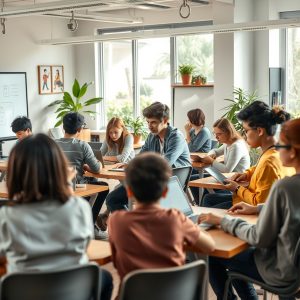
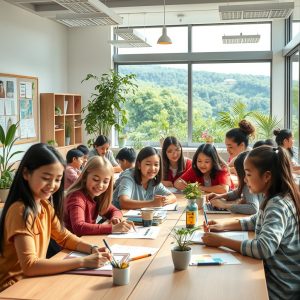
But the alchemy does not end with the individual. The true magic unfolds when these experiences are shared, when a group of students huddles around a problem, their voices weaving together like threads in a tapestry. One suggests a solution, another challenges it, a third refines it, and suddenly, the answer is not handed down from above but emerges from the collective. This is the crucible of collaborative learning, where the heat of differing perspectives tempers the steel of innovation.
The Whisper of the World Beyond
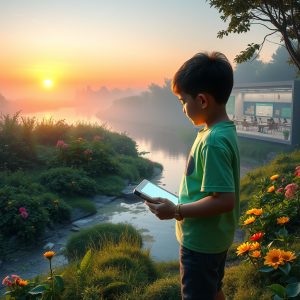
Yet, for all its power, the classroom is but a microcosm of the world. The most profound transformations occur when the boundaries between school and life dissolve, when education steps beyond the confines of four walls and into the messy, vibrant reality of community. A student planting a garden does not just learn about photosynthesis—they feel the soil between their fingers, witness the slow unfurling of a seedling, taste the bitterness of failure when a crop withers, and savor the sweetness of success when the first tomato ripens. This is the alchemy of real-world skill acquisition, where knowledge is not a destination but a living, breathing entity that grows with the learner.
And what of the teachers in this crucible? They are not mere instructors, but guides, alchemists in their own right, who know when to step back and let the fire do its work. Their role is not to provide answers, but to kindle questions, to fan the flames of curiosity until the student’s own hunger for understanding becomes the driving force. They understand that the most powerful lessons are not taught but caught, like embers carried on the wind, igniting something deep within the learner’s soul.
The Gold Beneath the Surface
There is a danger, of course, in romanticizing this process. The path of real-world learning is not always smooth; it is fraught with frustration, with setbacks, with moments when the lead of doubt threatens to overwhelm the gold of possibility. But it is in these moments that the true alchemy occurs. A student who has never struggled may never know the exhilaration of overcoming. A learner who has never failed may never taste the sweetness of resilience. The crucible does not promise ease, but it offers something far more valuable: the chance to emerge stronger, wiser, and more alive than before.
And so, the question lingers: What if education were not a series of hoops to jump through, but a journey of transformation? What if every lesson were not just a step toward a grade, but a step toward becoming? The alchemy of real-world learning suggests that the answers lie not in the destination, but in the process itself—the quiet, persistent work of turning the ordinary into the extraordinary, the routine into the remarkable, the lead of the everyday into the gold of discovery.
The Echo of What Might Be
Perhaps the most beautiful aspect of this alchemy is its ripple effect. A student who has tasted the thrill of discovery in the classroom carries that fire into the world beyond. They become the ones who ask, “What if?”—who challenge the status quo, who see problems not as obstacles but as invitations. They are the architects of their own futures, not because they were handed a blueprint, but because they learned to forge their own path. And in doing so, they remind us all that education is not a transaction, but a transformation—that the soul of learning is not in what we know, but in what we become.
The crucible does not discriminate. It does not favor the privileged or the gifted. It is a great equalizer, offering its magic to all who dare to step into the fire. And in that fire, something extraordinary happens: the lead of routine melts away, revealing the gold that was there all along, waiting to be discovered.