The Soul’s Atlas: How Tailored Pathways Illuminate the Inner Cartography of Learning
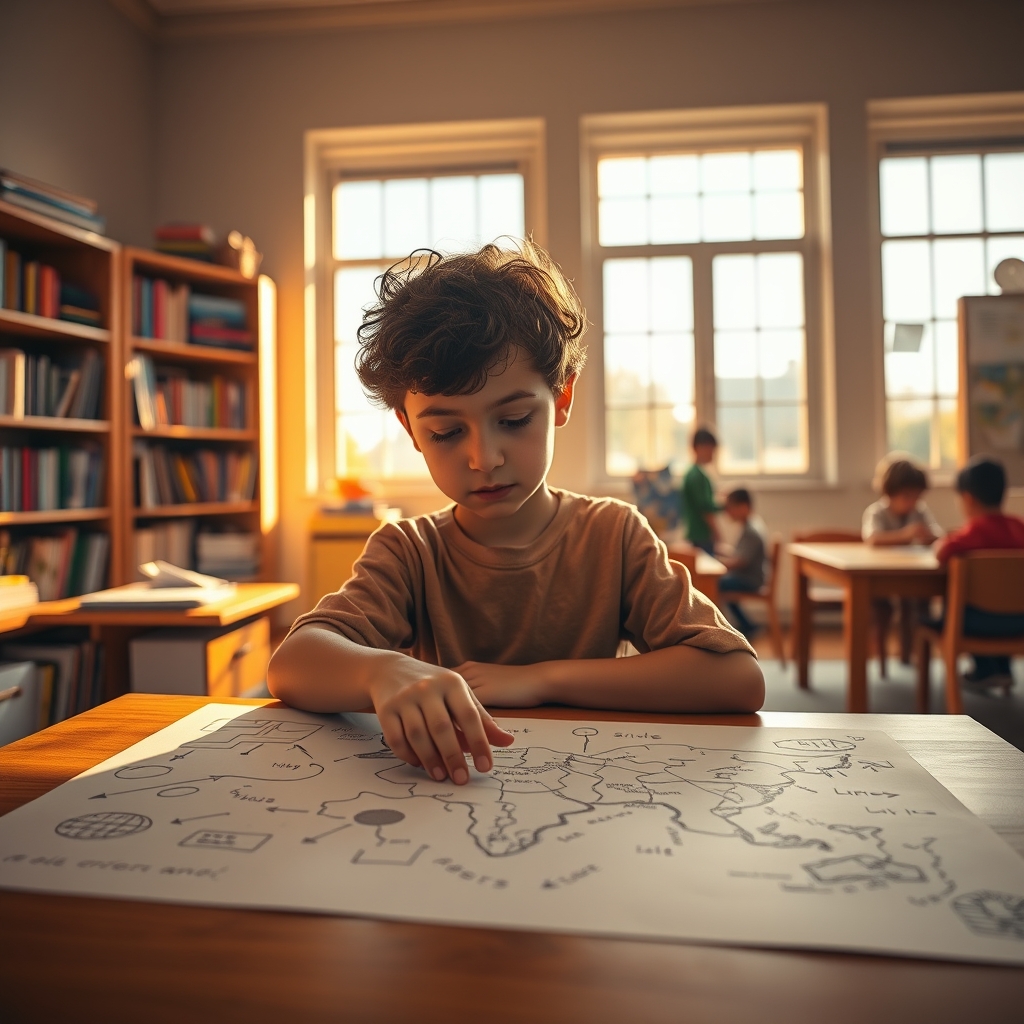
The first time I truly understood the weight of a child’s gaze, I was standing in a classroom where the walls hummed with the quiet electricity of discovery. It wasn’t the kind of room where desks were bolted to the floor or where silence was mistaken for discipline. Instead, it was a space where questions curled like smoke from the lips of eight-year-olds, where the air smelled of wax crayons and the faint, metallic tang of curiosity. That day, a boy named Eli traced his finger along a map he had drawn—not of continents or rivers, but of his own mind. “This is where I get lost,” he said, pointing to a jagged line near the center, “and this is where I find my way back.” His map was a labyrinth of scribbles and arrows, a testament to the fact that learning, at its core, is not a straight path but a winding journey through the uncharted territories of the self.
The Cartography of the Unseen
Education has long been treated as a one-size-fits-all garment, stitched together with standardized threads and measured by the rigid yardstick of grades. But what if we dared to imagine it as something far more fluid, more intimate? What if, instead of forcing every child into the same mold, we handed them the tools to sketch their own maps, to navigate the landscapes of their strengths and the swamps of their struggles? Tailored academic pathways are not merely about customization; they are about recognition—the quiet acknowledgment that every mind is a unique ecosystem, teeming with its own rhythms, its own seasons of growth.
Consider the way a river carves its path through stone, not by brute force, but by persistence, by the slow, patient insistence of water finding its way. A child’s learning journey is much the same. It meanders, it stumbles, it pools in unexpected places before surging forward again. The role of educators, then, is not to dam the flow but to guide it, to offer the occasional handrail when the current grows too swift. This is the essence of adaptive education strategies: the understanding that progress is not linear, that detours are not failures, and that the most profound lessons are often learned in the spaces between the expected and the unknown.
The Alchemy of Small Discoveries
There is a moment in every child’s education that feels like alchemy—a spark of understanding that transforms the leaden weight of confusion into the gleam of insight. For some, it arrives during a project-based learning exercise, when their hands are buried in clay or their eyes are fixed on a circuit board, and suddenly, the abstract becomes tangible. For others, it comes in the hush of a collaborative learning environment, when a classmate’s question unlocks a door they didn’t even know was there. These moments are the currency of personalized learning journeys, the quiet transactions where a child’s potential is not just recognized but celebrated.
I remember a girl named Mira, who spent weeks avoiding the math corner of her classroom, her shoulders hunched as if bracing against an invisible storm. Then, one day, her teacher introduced a game where numbers were not just symbols on a page but characters in a story, where addition and subtraction became the plot twists of an adventure. Mira’s resistance melted like ice in sunlight. She didn’t just learn math; she learned that struggle could be reframed as exploration, that frustration could be a signpost pointing toward growth. This is the power of a responsive curriculum design—it doesn’t just teach; it listens, it adapts, it meets the child where they are, not where the lesson plan says they should be.
The Geography of Belonging
No map is complete without its legends, its keys to understanding the symbols that dot the landscape. In the realm of education, these legends are the relationships that anchor a child’s journey—the teachers who see beyond the surface, the peers who offer a hand when the path grows steep, the parents who stand as steady lighthouses on the shore. Community-supported learning is not a buzzword; it is the invisible thread that weaves together the fabric of a child’s experience. It is the understanding that education is not a solitary endeavor but a collective act of creation, where every voice, every perspective, adds depth to the narrative.
In a world that often equates success with speed, with the relentless pursuit of the next milestone, there is something radical about slowing down. About sitting with a child’s question, not because it fits neatly into the day’s agenda, but because it matters. About recognizing that the most valuable lessons are not always the ones that can be measured on a test, but the ones that shape the heart. This is the soul of empathy-driven schooling: the belief that education is not just about filling minds but about nurturing spirits, about helping children understand that their stories are worth telling, their voices worth hearing.
The Unwritten Future
As I watch Eli’s map now, hanging on the wall of his classroom, I am struck by how much it resembles the constellations—messy, imperfect, but brimming with meaning. It is a reminder that the most important journeys are not the ones that follow a predetermined route, but the ones that allow us to wander, to wonder, to stumble and rise again. The future of education does not lie in more rigid structures or louder proclamations of what children should be, but in the quiet revolution of seeing them for who they are. It lies in the understanding that every child carries within them a universe of possibilities, and that our role is not to contain it, but to help them explore it, one star at a time.
The classroom of tomorrow is not a place of silence and stillness, but a living, breathing entity, a garden where every seed is given the space to grow in its own time, in its own way. It is a place where the curriculum is not a script but a conversation, where learning is not a destination but a dance. And perhaps, if we are lucky, it is a place where every child, no matter how lost they may feel in the labyrinth of their own mind, can find their way back to the light.