
The Silent Orchestra: How Digital Classroom Integration Composes the Soul of Modern Learning
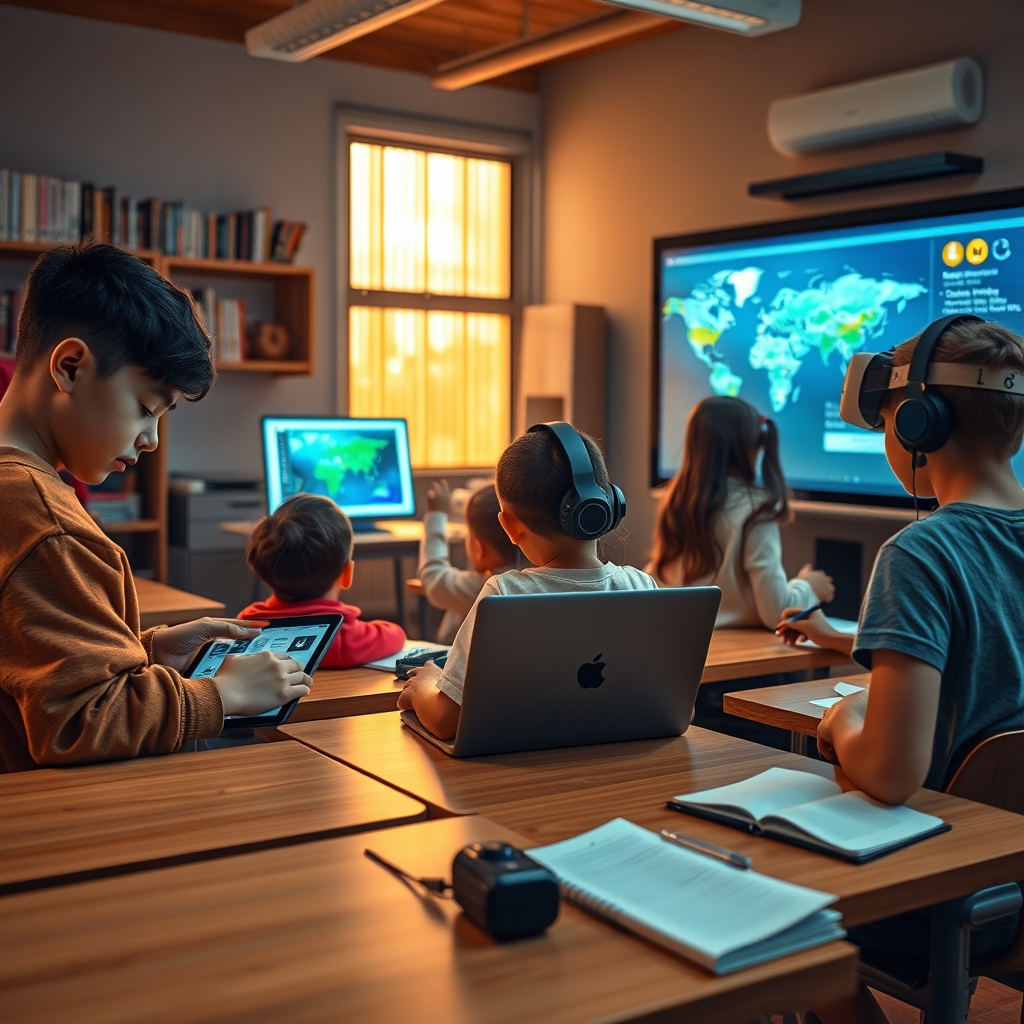
The first time I saw a child’s eyes widen at the glow of a tablet screen, I felt the quiet hum of something ancient and new colliding. There, in the soft blue light, was not just a device, but a portal—one that could either shrink the world into a series of cold, flickering tasks or expand it into a living, breathing landscape of discovery. The digital classroom is not merely a room with screens; it is an orchestra of silent possibilities, where every click, swipe, and keystroke has the potential to compose a symphony of understanding—or to drown out the music entirely.
The Alchemy of Pixels and Presence
Technology in education is often framed as a double-edged sword, a tool that can either liberate or imprison the mind. But what if we reframed it? What if, instead of seeing screens as distractions, we saw them as mirrors—reflecting not just our faces, but our curiosities, our fears, our unspoken questions? The most profound digital integrations are not those that replace the teacher, but those that amplify the human connection between learner and guide. A well-designed adaptive learning platform doesn’t just adjust to a student’s pace; it listens, like a patient mentor, to the rhythm of their struggle and the melody of their breakthroughs.
I remember watching a shy third-grader, fingers trembling, as she navigated a coding game that responded to her every input with encouragement. The program didn’t just teach her loops and variables; it taught her that her ideas had weight, that her mistakes were not failures but stepping stones. That moment was not about the technology itself, but about the way it held space for her to be seen, to be heard, in a way the traditional classroom sometimes couldn’t.
The Choreography of Collaboration
Digital classrooms are not solitary spaces. They are bustling marketplaces of ideas, where students from different continents can collaborate on a project as if they were sitting side by side. The screen becomes a bridge, not a barrier, when used to foster collaborative learning environments that transcend geography. I’ve seen children in rural villages and urban centers co-create stories, solve math puzzles, and debate historical events in real time, their voices weaving together like threads in a tapestry. The technology doesn’t erase their differences; it celebrates them, turning diversity into the very fabric of their shared experience.
Yet, for all its potential, the digital classroom can also become a hall of echoes if not guided with intention. Without empathy-driven scaffolding, screens can isolate as much as they connect. The key lies in designing interactions that require not just digital literacy, but emotional intelligence—spaces where students learn to listen as deeply as they type, to question as thoughtfully as they click. The best digital tools are those that fade into the background, leaving only the hum of human connection in their wake.
The Unseen Curriculum of the Screen
What we often overlook in the rush to integrate technology is the hidden curriculum it carries—the values, biases, and assumptions embedded in its design. A math app that rewards speed over reflection teaches a different lesson than one that celebrates persistence. A history platform that centers only certain narratives shapes not just knowledge, but identity. The digital classroom is never neutral; it is a living text, written and rewritten with every line of code, every algorithm, every interface choice.
This is where responsive curriculum design becomes an act of resistance. It demands that we ask not just how to use technology, but why. It challenges us to create digital spaces that honor the whole child—not just their cognitive abilities, but their emotional landscapes, their cultural contexts, their unique ways of seeing the world. When done well, digital integration doesn’t just teach content; it teaches how to be in a world where technology and humanity are increasingly intertwined.
The Fragile Balance of Innovation and Intimacy
There is a tension at the heart of the digital classroom—a pull between the efficiency of automation and the messiness of human connection. We risk losing something sacred when we replace the warmth of a teacher’s voice with the cold precision of an AI tutor, or when we trade the spontaneity of classroom discussion for the sterility of a pre-programmed lesson. Yet, when wielded with care, technology can also deepen intimacy. It can give a nonverbal child a voice, a struggling reader a lifeline, a curious mind a universe to explore.
The challenge is to remember that technology is not the destination, but the vessel. It is the means by which we navigate the vast ocean of knowledge, but it is not the shore. The real work of education—nurturing inquisitive growth mindsets, fostering student well-being, cultivating real-world skill acquisition—happens in the quiet spaces between the pixels, in the moments when the screen fades and the soul steps forward.
The Soul’s Echo in the Digital Age
Perhaps the greatest paradox of the digital classroom is that, in an era of hyper-connectivity, we are more in danger of losing touch with what it means to be human than ever before. The screens that promise to bring us closer can also push us further apart, if we let them. But if we approach them with intention, with reverence, with a deep commitment to the holistic development of every child, they can become something extraordinary: not just tools, but companions on the journey of learning.
I think back to that third-grader, her fingers no longer trembling, her eyes alight with the thrill of creation. The screen was just a canvas, but what she painted on it was entirely her own—a testament to the fact that technology, at its best, doesn’t replace the soul of education. It amplifies it. And in that amplification, we find not just knowledge, but wonder; not just information, but meaning; not just a classroom, but a world.
The digital age is not coming. It is here. And in its glow, we have a choice: to let the light blind us, or to use it to see more clearly than ever before. The orchestra is playing. The question is, will we listen?