The Lantern and the Labyrinth: How Empathy Lights the Path Through Student-Centric Education
The first time I watched a child stand at the edge of their own understanding, I realized how much of learning is not about the destination, but the courage to take the next step into the unknown. There is a quiet moment—almost sacred—when a student hesitates, not from lack of ability, but from the weight of possibility. What if I fail? What if I’m not enough? These unspoken questions linger in the air like mist, and it is in these moments that education reveals its true nature: not as a ladder to climb, but as a labyrinth to navigate, where every turn is both a challenge and an invitation.
The Labyrinth as Metaphor
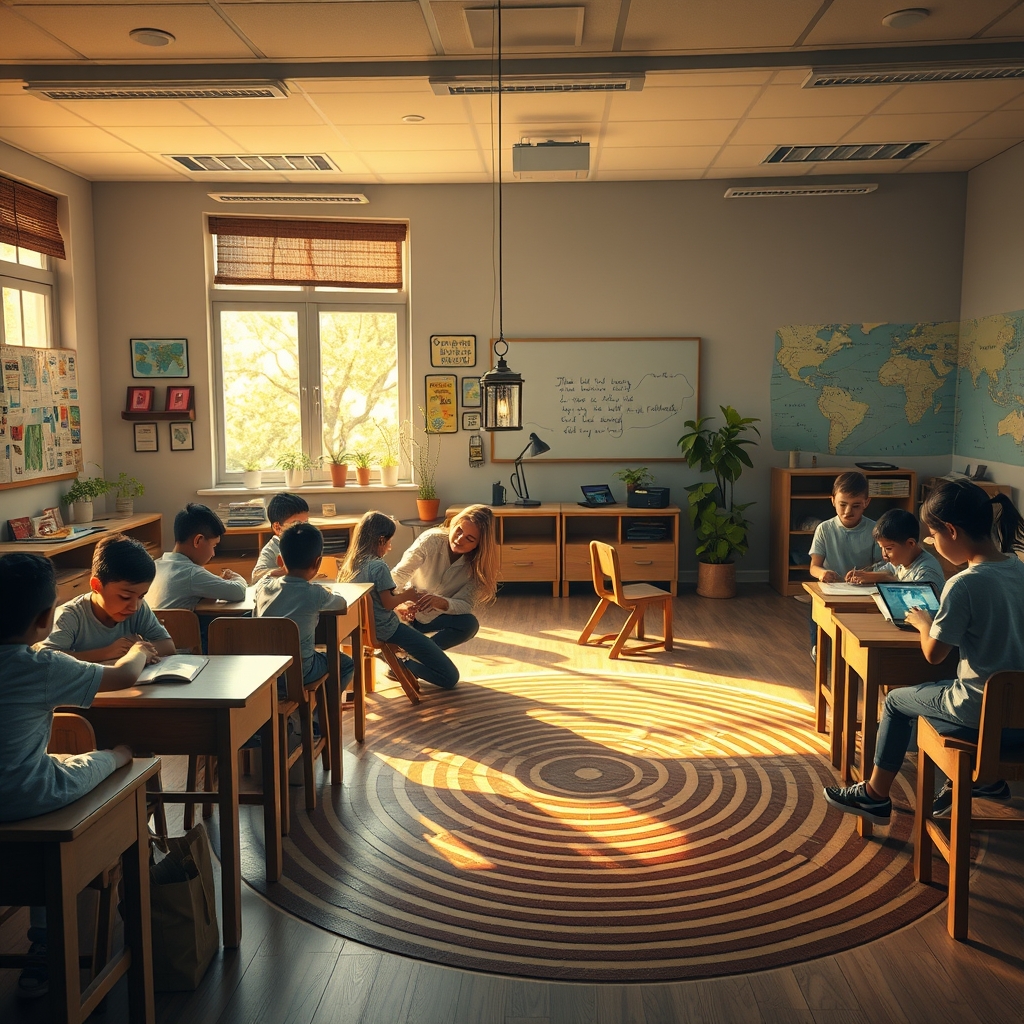
The labyrinth has long been a symbol of the human journey—winding, unpredictable, yet leading always toward the center. In a student-centric classroom, the labyrinth is not a maze with dead ends, but a living, breathing space where each learner’s path is acknowledged, honored, and illuminated. The walls of this labyrinth are not barriers; they are the contours of a mind in motion, shaped by curiosity, doubt, and the slow, steady work of understanding. Here, the teacher is not the guide who knows the way, but the lantern-bearer who walks beside, casting light just far enough for the next step to be taken with confidence.
This is the essence of empathy-driven schooling: the recognition that learning is not a linear process, but a deeply personal one. It is the art of seeing the child not as a vessel to be filled, but as a flame to be kindled. When we design classrooms that honor this truth, we create spaces where struggle is not a sign of weakness, but a necessary part of growth. The labyrinth does not demand perfection; it demands presence. And in that presence, students learn not just facts, but the shape of their own resilience.
The Lantern of Empathy
Empathy, in education, is not a soft skill—it is the foundation upon which all meaningful learning is built. It is the quiet voice that says, I see you. I hear you. Your journey matters. In a world that often measures success by speed and efficiency, empathy asks us to slow down, to listen, and to trust that the child’s pace is not a delay, but a rhythm worth honoring. This is where responsive curriculum design comes into play. A curriculum that adapts to the learner, rather than forcing the learner to adapt to it, is one that acknowledges the labyrinth’s twists and turns. It is flexible, not because it lacks structure, but because it understands that structure must serve the soul, not the other way around.
Consider the child who learns best through movement, whose fingers trace the air as if writing invisible equations. Or the one who speaks in metaphors, whose understanding of history is not a timeline, but a tapestry of human emotion. In a traditional classroom, these learners might be asked to conform, to sit still, to think in straight lines. But in an empathy-driven space, their ways of knowing are not just accommodated—they are celebrated. The lantern of empathy shines brightest when it reveals the unique pathways each child takes toward understanding, and when it refuses to let any of them fade into the shadows.
The Alchemy of Small Moments
It is often the smallest moments that carry the most weight. A teacher kneeling beside a student’s desk, not to correct, but to ask, What do you notice? A pause in the lesson to acknowledge a student’s frustration, not with solutions, but with solidarity. These are the gestures that transform a classroom from a place of instruction into a space of collaborative learning. They are the threads that weave trust, the invisible architecture that holds the weight of a child’s heart as they navigate the labyrinth.
In these moments, education becomes less about transmitting knowledge and more about co-creating it. When students are invited to bring their questions, their doubts, and their unique perspectives into the learning process, the classroom becomes a living ecosystem, where every voice contributes to the collective understanding. This is the power of project-based learning and real-world skill acquisition—they do not just teach content; they teach children how to engage with the world as thinkers, creators, and problem-solvers. The labyrinth is no longer a solitary journey, but a shared exploration, where the lantern’s light is multiplied by the number of hands holding it.
The Light That Lingers
There is a particular kind of light that lingers in the memory of a student long after the lesson has ended. It is not the light of a correct answer, but the light of being seen—truly seen—in all one’s complexity. It is the light of a teacher who noticed the way a student’s eyes lit up when they talked about the stars, or who remembered the name of the book they couldn’t put down. This light is the essence of holistic development programs, which recognize that education is not just about the mind, but the heart, the spirit, and the hands that will one day shape the world.
When we integrate digital classroom tools with this kind of intentionality, we create opportunities for that light to reach even further. A well-designed adaptive learning platform can meet a student where they are, offering challenges that are neither too easy nor too hard, but just right for their unique journey. Yet, no amount of technology can replace the human touch—the moment when a teacher leans in and says, I believe in you. It is this combination of innovation and empathy that allows the labyrinth to be navigated not with fear, but with wonder.
The Unseen Compass
Deep within the labyrinth, there is a compass that does not point north, but inward. It is the compass of inquisitive growth mindset, the quiet voice that whispers, You are capable of more than you know. This compass is not given; it is cultivated, through experiences that challenge, support, and ultimately, expand a child’s sense of what is possible. It is the gift of positive learning experiences, where failure is not a dead end, but a detour that leads to unexpected discoveries. And it is the promise of sustainable education models, which recognize that the goal of learning is not to reach the end of the labyrinth, but to emerge from it with a deeper understanding of oneself and the world.
Perhaps the most beautiful thing about the labyrinth is that it is never truly finished. There are always new paths to explore, new questions to ask, new ways to grow. And when we walk alongside our students with empathy as our lantern, we do more than light the way—we remind them that they, too, carry light within. That the labyrinth is not something to be conquered, but something to be lived, one courageous step at a time. And that, in the end, the journey itself is the destination.