
The Labyrinth of Light: How the Shadows of Neurodiversity Illuminate the Path to Inclusive Education
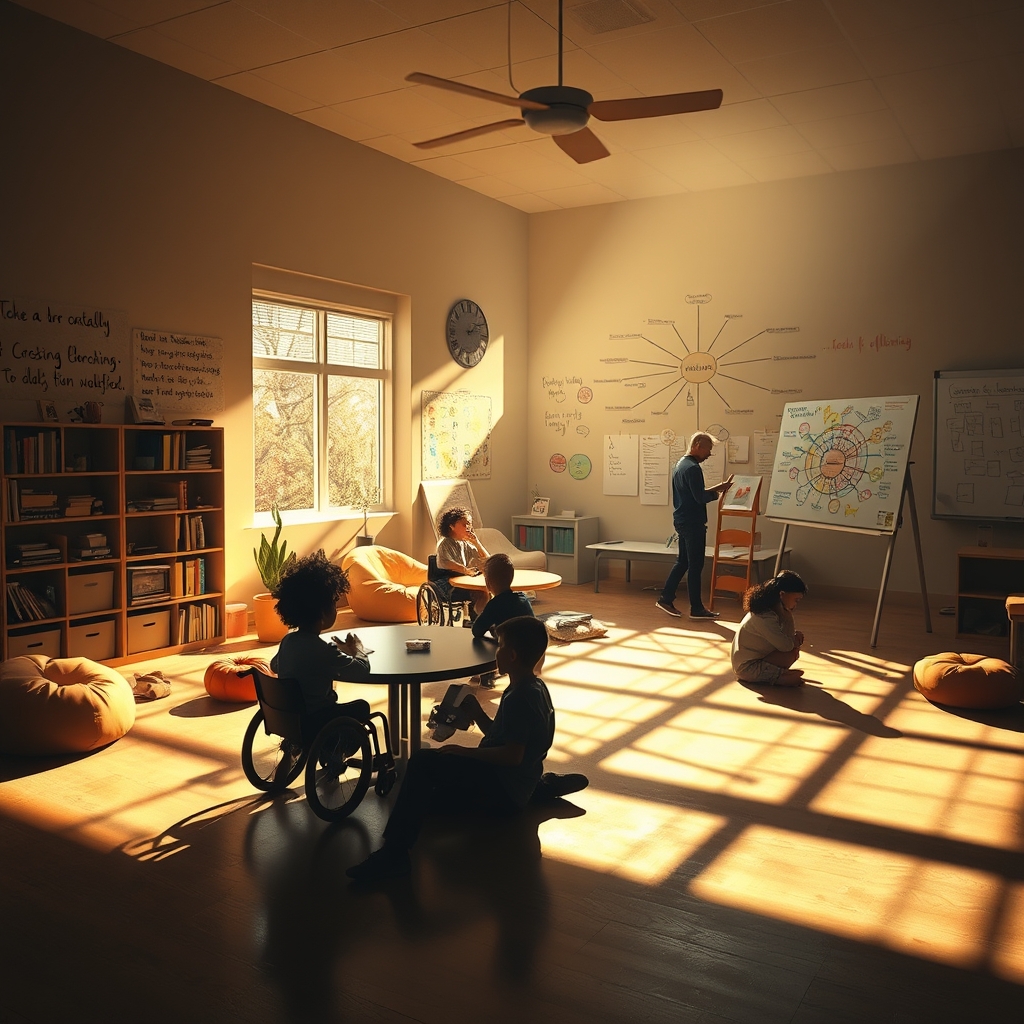
The classroom is not a monolith of stillness, but a living, breathing labyrinth—each corridor a whisper of possibility, each shadow a story waiting to be told. We walk its halls with the weight of expectations, our footsteps echoing against the walls of what we believe education should be. Yet, it is in the quiet corners, where the light fractures and bends, that we begin to see the truth: the labyrinth was never meant to be navigated alone. It is a shared journey, one where the brilliance of neurodiversity does not merely add color to the path but redefines the very shape of the journey itself.
The Cartography of the Unseen
There is a map drawn in invisible ink, its lines etched not by geography but by the contours of the mind. For too long, we have measured the worth of a child’s journey by how closely it mirrors the well-trodden paths of convention. But what if the detours—the moments of stimming, the pauses of processing, the bursts of hyperfocus—are not deviations from the path but the path itself? Neurodiversity is not a disruption to the order of learning; it is the order, a different rhythm in the symphony of human cognition. To ignore it is to silence a melody that could transform the entire composition.
Consider the child who sees the world in patterns, whose mind leaps across connections like a stone skipping over water. In a system designed for linear progression, their brilliance may be mislabeled as distraction, their depth as disorder. Yet, it is precisely this way of seeing that could unravel the knots of problems we have long considered unsolvable. The labyrinth of light is not a straight line but a spiral, where every turn reveals a new perspective, a new way of understanding. When we force all learners to walk the same path, we do not just limit them—we limit the very potential of what education can be.
The Alchemy of Adaptation
Differentiated instruction is not a pedagogical trend but a necessity, a recognition that the alchemy of learning requires more than a one-size-fits-all elixir. It is the art of meeting a child where they are, not where the curriculum dictates they should be. This is not about lowering standards but about redefining them, about understanding that mastery is not a destination but a spectrum of possibility. The child who struggles to read aloud may write poetry that stuns with its precision. The student who cannot sit still may design solutions to problems that have stumped engineers for decades. Adaptive learning methods are not accommodations; they are invitations—to see, to engage, to thrive in ways that honor the unique architecture of each mind.
Yet, adaptation is not just about tools or strategies. It is about the quiet revolution of the heart, the moment a teacher realizes that their role is not to mold a child into the shape of the system but to help the system bend to the shape of the child. It is in the pause before answering a question, the choice to offer a fidget tool instead of a reprimand, the decision to celebrate the process as much as the product. These are the small acts of alchemy that turn the leaden weight of exclusion into the gold of belonging.
The Unspoken Language of Belonging
Belonging is not a policy or a program but a language, one spoken in the spaces between words. It is the way a teacher remembers the name of a student’s favorite book, the way a peer offers a seat without being asked, the way a classroom is designed to welcome rather than confine. Inclusive education is not about erasing differences but about creating a space where those differences are not just tolerated but celebrated. It is about understanding that the child who flaps their hands in excitement is not disrupting the lesson but adding to its richness, that the student who needs noise-canceling headphones is not withdrawing but engaging in their own way.
This language of belonging is not always spoken aloud. It is in the way a teacher adjusts the lighting for a child sensitive to glare, in the way a lesson plan includes multiple ways to demonstrate understanding, in the way a school prioritizes mental health as much as academic achievement. It is in the unspoken promise that every child, regardless of how their mind works, has a place at the table. And it is in the quiet moments—when a student who has spent years feeling invisible finally sees themselves reflected in the curriculum, in the stories, in the very fabric of the classroom—that the language of belonging becomes a home.
The Shadows That Teach Us to See
We often fear the shadows in the labyrinth, mistaking them for dead ends rather than doorways. But it is in the shadows that we learn to see differently. The child who struggles with social cues teaches us the value of patience. The student who processes information slowly reminds us that depth is not measured by speed. The learner who needs movement to think shows us that the body and mind are not separate but intertwined. Neurodiversity is not a challenge to overcome but a gift to embrace, a reminder that the world is far more complex, far more beautiful, than we have been taught to believe.
When we design classrooms that honor these differences, we do not just create spaces for neurodivergent learners—we create spaces for all learners. A classroom that values sensory needs becomes a sanctuary for the child with anxiety. A lesson that offers multiple entry points becomes a lifeline for the student who learns differently. An environment that celebrates diverse ways of thinking becomes a crucible for innovation, where the next great idea may come from the child who sees the world in a way no one else does. The shadows are not obstacles; they are the very things that allow the light to take shape.
The labyrinth of light is not a place we arrive at but a journey we undertake together. It is in the shared act of learning, of stumbling, of finding our way, that we begin to see the beauty of the path—not in spite of its twists and turns, but because of them. For it is in the shadows that we learn to see the light, and in the differences that we discover the true meaning of belonging. The classroom is not a place where we all become the same; it is a place where we all become more fully ourselves, where the unique spark of every child is not just acknowledged but cherished. And in that cherishing, we find the heart of what education was always meant to be.