
The Soul’s Riverbed: How the Gentle Erosion of Experiential Transitions Shapes the Hidden Valleys of a Child’s Heart
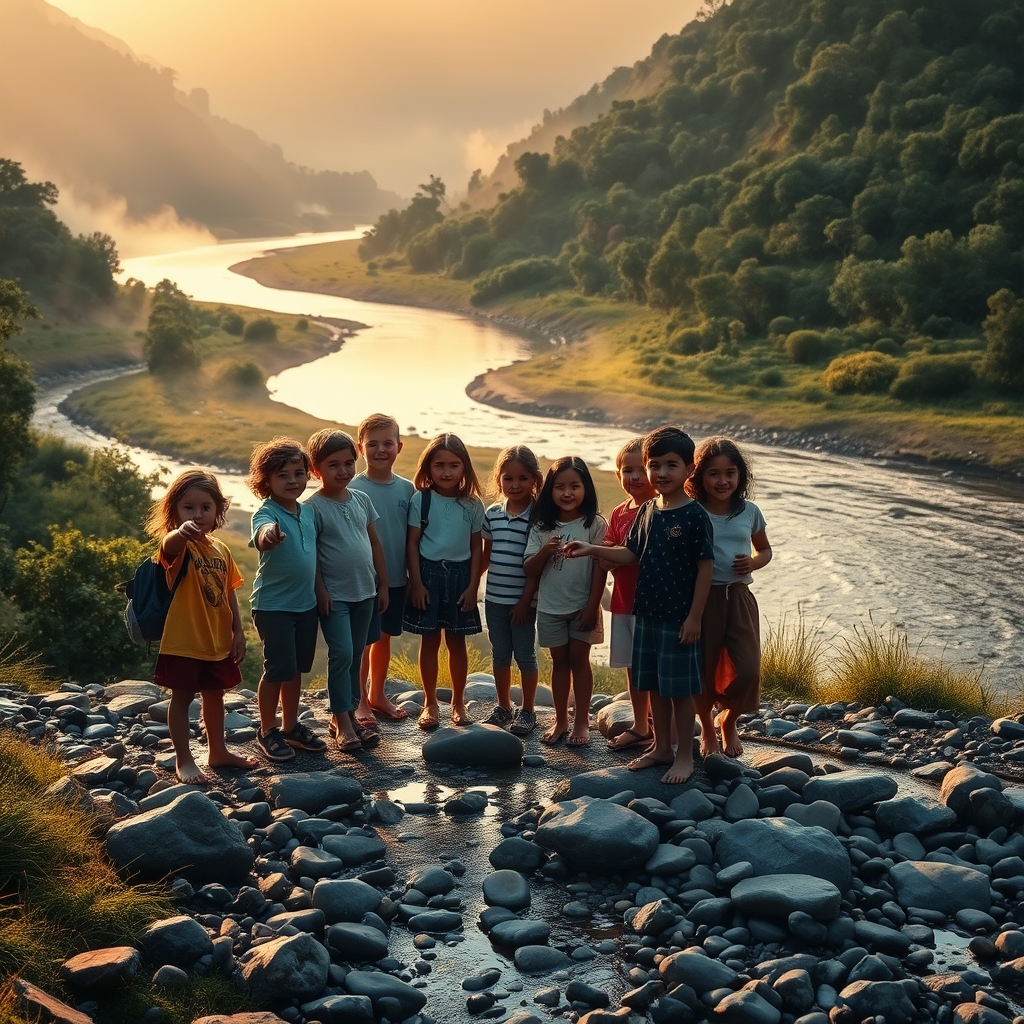
There is a quiet magic in the way a river carves its path—not through force, but through persistence, through the slow, relentless dance of water against stone. It does not demand; it simply flows, shaping the land in ways unseen until the moment the light catches the curve of a canyon, revealing the beauty of what has always been there. So too does the journey of a child through the shifting landscapes of learning unfold, not in grand declarations, but in the subtle, cumulative moments of transition—those thresholds where one way of knowing gives way to another, where the familiar dissolves into the unknown, and where the soul, like the riverbed, is reshaped by the currents of experience.
The Threshold of Becoming
I remember the first time I stood at the edge of such a threshold, though I did not recognize it then. It was the summer before I began at a new school, one that promised something different—something alive. The brochures spoke of “experiential learning” and “student-centric education,” words that felt both thrilling and vague, like the first breath of wind before a storm. My parents, ever the optimists, framed it as an adventure, but my stomach twisted with the weight of the unknown. What if the river I had grown accustomed to—the one with its predictable bends and familiar banks—was not the river I was meant to follow?
That first day, I stepped into a classroom that looked nothing like the ones I had known. There were no rows of desks, no teacher standing at the front like a sentinel of knowledge. Instead, there were clusters of tables, walls covered in maps and sketches, and a hum of voices weaving together like threads in a tapestry. A teacher—no, a guide—smiled and said, “Today, we begin with a question.” Not a lecture. Not a test. A question. And just like that, the threshold dissolved beneath my feet, and I was carried forward by the current.
The Alchemy of Letting Go
Transitions, I have come to understand, are not merely about moving from one place to another. They are about surrender. They are about the courage to release the grip on what was, to trust that what lies ahead—though unseen—holds its own kind of wisdom. In traditional classrooms, the path is often laid out like a straight line, a march from point A to point B, with little room for detours or pauses. But in the world of experiential learning, the path is more like a river delta, branching and recombining, each tributary offering its own lessons, its own challenges, its own quiet revelations.
I recall a project in that first year—one that asked us to build a bridge using only the materials we could forage from the surrounding woods. There were no instructions, no rubrics, no step-by-step guides. Just a problem to solve, a need to meet, and the collective intelligence of our small group. We argued, we failed, we laughed, we tried again. And when that bridge finally held the weight of one of us crossing it, the triumph was not just in the structure itself, but in the realization that we had become something more than students. We had become collaborators, problem-solvers, learners in the truest sense of the word. The transition from passive recipient to active participant was not announced with fanfare; it happened in the quiet moments between the failures and the small victories, in the way our hands learned to work together before our minds could catch up.
The Whisper of the Unseen Curriculum
What is often overlooked in these transitions is the invisible curriculum—the lessons that are not written in any syllabus but are woven into the very fabric of the experience. It is the way a child learns to navigate conflict when a group project stalls, or the way they discover resilience when a hypothesis fails in a science experiment. It is the way they begin to see themselves not as vessels to be filled, but as co-creators of their own education. These are the lessons that shape the soul as much as the mind, the ones that linger long after the details of a lesson have faded.
In my own journey, one of the most profound transitions was the shift from seeking approval to seeking understanding. Early on, I measured my worth by the grades I received, by the praise of my teachers, by the external validation that told me I was “doing it right.” But as I moved through environments that valued process over product, curiosity over compliance, I began to ask different questions. Not “What do I need to do to get an A?” but “What do I need to understand to make this better?” Not “How can I please my teacher?” but “How can I contribute to this conversation?” The river of my education had carried me to a place where the destination was no longer a fixed point, but a horizon that expanded with every step I took.
The River Remembers
Years later, I find myself standing at the banks of that same river, though the landscape has changed. I am no longer the child stepping nervously into the unknown, but I am still learning—still being shaped by the currents of experience. What I have come to realize is that the most meaningful transitions are not the ones that leave us unchanged, but the ones that leave us more ourselves. They are the moments when we are asked to stretch, to risk, to grow in ways that feel both exhilarating and terrifying. And though the process may feel like erosion—like the slow wearing away of what we once were—it is, in truth, the very thing that reveals the shape of who we are meant to become.
Perhaps this is the greatest gift of experiential transitions: they teach us that growth is not a straight line, but a spiral. We circle back to familiar places, but we are never the same. The river remembers every bend, every stone it has shaped, every life it has carried. And so do we. The child who once stood at the threshold of a new way of learning is still here, not as a memory, but as a layer of the self—one of many that have been shaped by the gentle, relentless flow of experience. And if we listen closely, we can hear the whisper of the river, reminding us that the journey is not about reaching the destination, but about becoming the kind of person who can navigate the currents with courage, with curiosity, and with an open heart.