The Soul’s Garden: How the Whisper of Holistic Development Blooms in the Hidden Valleys of a Child’s Being

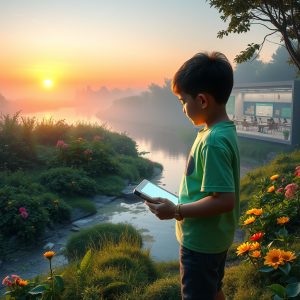
There is a quiet magic in the way a seed knows to push through the dark earth, reaching not just for the light, but for the very shape of its own becoming. It does not rush, nor does it falter—it simply grows, guided by an inner compass older than memory. In the same way, a child’s soul unfurls in the unseen valleys of their being, not through force or haste, but through the gentle nurturing of a thousand small, intentional moments. This is the essence of holistic development: the understanding that education is not merely the transfer of knowledge, but the cultivation of a life in its fullest, most radiant expression.
The Soil of Being
What does it mean to tend to the soil of a child’s being? It is not enough to fill their minds with facts or their days with tasks. True growth requires something deeper—a recognition that the roots of learning stretch far beyond the classroom walls. The soil must be rich with empathy, tilled with patience, and watered with the kind of love that does not demand, but simply is. When a child feels seen in their entirety—not just as a student, but as a person with dreams, fears, and a unique rhythm of their own—they begin to trust the process of their own unfolding.
I remember the first time I witnessed this trust in action. A young girl, no older than seven, stood before a blank canvas in an art class, her brow furrowed in concentration. She was not following instructions; she was listening to something else, an inner voice that whispered of colors and shapes beyond the ones prescribed. The teacher, instead of correcting her, knelt beside her and asked, “What is your painting trying to say?” That simple question was a seed planted in fertile ground. It did not matter that the girl’s creation did not resemble the example on the board. What mattered was that she had been given permission to listen to the quiet wisdom of her own imagination.
The Rain of Experience
Holistic development is not a destination, but a journey of small, rain-soaked steps. Each experience—whether it is the sting of failure, the warmth of a shared laugh, or the quiet triumph of mastering a new skill—adds a layer of depth to the soul’s landscape. These moments are not isolated; they are threads in a tapestry, each one contributing to the larger pattern of who the child is becoming. And yet, how often do we rush past these moments, mistaking urgency for importance?
Consider the way a child learns to ride a bicycle. There is no textbook for balance, no lecture on perseverance. There is only the wobble, the fall, the scraped knee, and the outstretched hand of someone who believes in them. The lesson is not in the instruction, but in the doing. It is in the way the child’s body remembers the tilt of the handlebars, the way their breath catches as they pedal faster, the way their heart swells with the realization that they are capable of more than they knew. This is experiential learning in its purest form: the kind that leaves no room for doubt, because the proof is written in the very cells of their being.
The Roots of Belonging
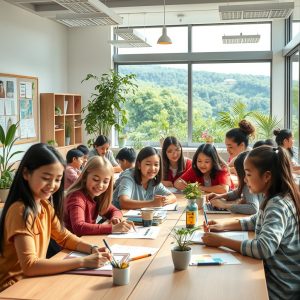
No garden grows in isolation. Even the hardiest of plants needs the company of others—the shade of a tree, the support of a trellis, the symbiotic dance of roots beneath the soil. In the same way, a child’s development thrives in the context of community. It is in the shared laughter of a classroom, the collective gasp of discovery during a science experiment, the quiet solidarity of a group project that a child learns the most profound lesson of all: that they are not alone.
I once visited a school where the walls were not barriers, but invitations. The classrooms spilled into gardens, the gardens into playgrounds, and the playgrounds into the wider world. Children moved between spaces not as students following a schedule, but as explorers charting a course of their own making. They worked in groups, but not because they were told to—because they had discovered the joy of collaboration. They asked questions, not to please a teacher, but because curiosity had become a habit. And when they stumbled, they were not met with correction, but with curiosity: “What did you learn from that?” The question was not a test, but an acknowledgment that every misstep was a step forward in disguise.
The Light of Recognition
Perhaps the most transformative aspect of holistic development is the way it honors the unseen. It is easy to measure a child’s progress in grades or test scores, but how do we measure the quiet courage of a shy child raising their hand for the first time? How do we quantify the moment a child realizes they are not defined by their struggles, but by their resilience? These are the moments that shape a life, and yet they often go unnoticed in the rush of academic milestones.
I think of a boy I knew who struggled with reading. The letters on the page seemed to dance and blur, no matter how hard he tried. His teachers, instead of focusing solely on remediation, began to ask different questions: “What stories do you love to hear? What worlds do you imagine when you close your eyes?” They introduced him to audiobooks, to storytelling circles, to the idea that literacy was not just about decoding words, but about connecting with the soul of a story. Slowly, his relationship with reading shifted. It was no longer a source of shame, but a bridge to the worlds he longed to explore. The change was not just in his reading level, but in the way he carried himself—no longer hunched over a book in frustration, but sitting tall, his eyes alight with possibility.
The Harvest of Becoming
What does it mean to harvest the fruits of holistic development? It is not a single moment of achievement, but a lifetime of small, radiant awakenings. It is the way a child’s face lights up when they realize they have something to offer the world. It is the quiet confidence that comes from knowing they are capable of growth. It is the way they begin to see themselves not as passive recipients of education, but as active participants in the unfolding of their own lives.
And yet, the most beautiful thing about this garden is that it is never truly finished. There is always another seed to plant, another layer of soil to enrich, another moment of growth waiting just beneath the surface. The child who once struggled to read becomes the teenager who writes poetry. The girl who painted outside the lines grows into the woman who sees the world in colors others cannot. The boy who wobbled on his bicycle becomes the young man who rides with the wind at his back, unafraid of the road ahead. These are not just outcomes; they are the natural, inevitable blooms of a life tended with care, with patience, and with the deep, abiding belief that every child is a garden waiting to grow.
The soul does not flourish in straight lines or rigid structures. It bends toward the light, it reaches for the rain, it sends its roots deep into the earth, searching for something it cannot name but knows is there. And when we create spaces that honor this truth—spaces that are flexible, nurturing, and alive with possibility—we do more than educate. We become gardeners of the soul, tending to the quiet, miraculous work of becoming.