The Soul’s Crucible: How the Fire of Collaborative Learning Forges the Unseen Bridges of a Child’s Inner World

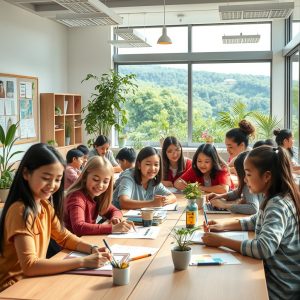
There is a quiet magic in the way children lean into one another, their voices weaving through the air like threads of an invisible tapestry. It is not the loudest voice that carries the most weight, nor the most confident stance that holds the room—it is the way their eyes light up when they realize they are not alone in their wondering. This is the essence of collaborative learning, a crucible where the fire of shared curiosity forges something far greater than the sum of its parts. It is where the soul of education begins to take shape, not in isolation, but in the delicate dance of minds meeting, questioning, and growing together.
The Alchemy of Shared Wonder
In a world that often prizes individual achievement, there is something profoundly countercultural about the act of learning together. It requires vulnerability—the willingness to admit, “I do not know,” and the courage to ask, “What do you think?” This alchemy of shared wonder does not happen by accident. It is cultivated in spaces where children are encouraged to bring their whole selves to the table, where their questions are met not with answers, but with more questions. The classroom becomes a laboratory of ideas, where hypotheses are tested not against a rubric, but against the collective wisdom of the group.
Imagine a child who struggles with numbers, their fingers tracing patterns in the air as they try to grasp a concept just beyond their reach. Now picture another child, one who sees the world in equations, offering not a solution, but a different way of looking. Together, they build a bridge—not just over the chasm of a math problem, but over the divide between their unique ways of understanding. This is the power of collaborative learning: it does not erase differences, but transforms them into strengths. The child who struggles becomes the one who asks the questions that unlock new perspectives, while the child who excels learns the humility of seeing the world through another’s eyes.
The Echoes of Belonging
There is a deep human need to be seen, to be heard, to belong. In traditional classrooms, this need is often met—or unmet—by the invisible hierarchies of achievement. The child who raises their hand first, who scores highest on tests, who fits neatly into the mold of “success” is celebrated, while others fade into the background, their voices drowned out by the noise of competition. Collaborative learning disrupts this dynamic. It creates a space where every voice has weight, where the quiet observer is just as essential as the outspoken leader. The echoes of belonging resonate not in the loudest moments, but in the silent nods of understanding, the shared laughter over a failed experiment, the collective sigh of relief when a problem is finally solved.
This sense of belonging is not just a byproduct of collaboration—it is its foundation. When children feel safe to take risks, to make mistakes, to be imperfect, they begin to see themselves not as isolated learners, but as part of something larger. They learn that their ideas matter, not because they are the “right” ones, but because they contribute to the collective journey. This is where the soul of education is nurtured—not in the accumulation of facts, but in the realization that learning is a shared human experience.
The Unseen Architecture of Connection
What is built in these moments of collaboration is not always visible. It does not appear on standardized tests or in neatly graded assignments. It is the architecture of connection, the invisible scaffolding that supports a child’s inner world. When a group of children work together to design a project, they are not just building a model or writing a report—they are building trust. They are learning to navigate conflict, to listen deeply, to advocate for their ideas while remaining open to others. These are the skills that will serve them long after they leave the classroom, the ones that will help them navigate the complexities of relationships, work, and life itself.
Consider the child who has always been told they are “too sensitive,” their emotions dismissed as a weakness. In a collaborative environment, their sensitivity becomes a strength. They are the ones who notice when a teammate is struggling, who ask the questions that others are too afraid to voice. They learn that their emotional intelligence is not a liability, but a gift—one that enriches the group and deepens the learning experience for everyone. This is the unseen architecture of connection: the realization that our differences are not obstacles to be overcome, but bridges to be built.
The Fire That Forges the Future
The crucible of collaborative learning is not a gentle place. It is a space of heat and pressure, where ideas are tested, where assumptions are challenged, where children learn to stand firm in their convictions while remaining open to change. It is here that resilience is forged—not the brittle kind that shatters under pressure, but the kind that bends and adapts, that grows stronger with each challenge. This is the fire that prepares children for the future, a future that will demand not just knowledge, but the ability to think critically, to work with others, to navigate uncertainty with grace.
Yet, for all its intensity, there is a tenderness to this process. It is in the way a child’s face softens when they realize they have been heard, in the quiet pride of a group that has overcome a challenge together, in the unspoken understanding that they are part of something greater than themselves. This is the soul of collaborative learning: the recognition that we are all learners, all teachers, all capable of growth when we allow ourselves to be shaped by the fire of shared experience.
The classroom fades, the years pass, but the echoes of these moments linger. They become the foundation upon which children build their lives, the invisible threads that connect them to one another long after the lesson is over. For in the end, education is not about the content we deliver, but the connections we forge—the bridges we build across the divides of difference, the fires we tend in the crucible of shared wonder. And it is in these moments, when children lean into one another with open hearts and curious minds, that the true magic of learning begins to unfold.