The Soul’s Lantern: How Empathy Lights the Hidden Pathways of a Student’s Inner World
There is a quiet moment, just before dawn, when the world holds its breath. The air is still, the shadows soft, and the first pale light lingers like a question at the edge of the horizon. It is in this hush that I often find myself reflecting on the true essence of education—not as a system of measurements or milestones, but as a journey of illumination, where the soul of a learner is gently coaxed into revealing its own hidden contours. What if the most profound lessons are not those we teach, but those we hold space for? What if the greatest gift we can offer a child is not knowledge, but the courage to explore the uncharted landscapes within?
The Unseen Geography of a Child’s Heart
Every child carries within them a world as vast and intricate as the night sky. Some stars burn bright and steady, while others flicker uncertainly, obscured by clouds of doubt or fear. The traditional classroom, with its rigid desks and standardized tests, often feels like an attempt to map this inner cosmos with a ruler and protractor—tools ill-suited for the fluid, ever-shifting terrain of a young mind. But what if we dared to approach education as explorers rather than cartographers? What if we traded our blueprints for lanterns, and our lesson plans for the quiet patience of a guide who knows that the most important discoveries are not found on a syllabus, but in the unspoken questions that haunt a child’s eyes?
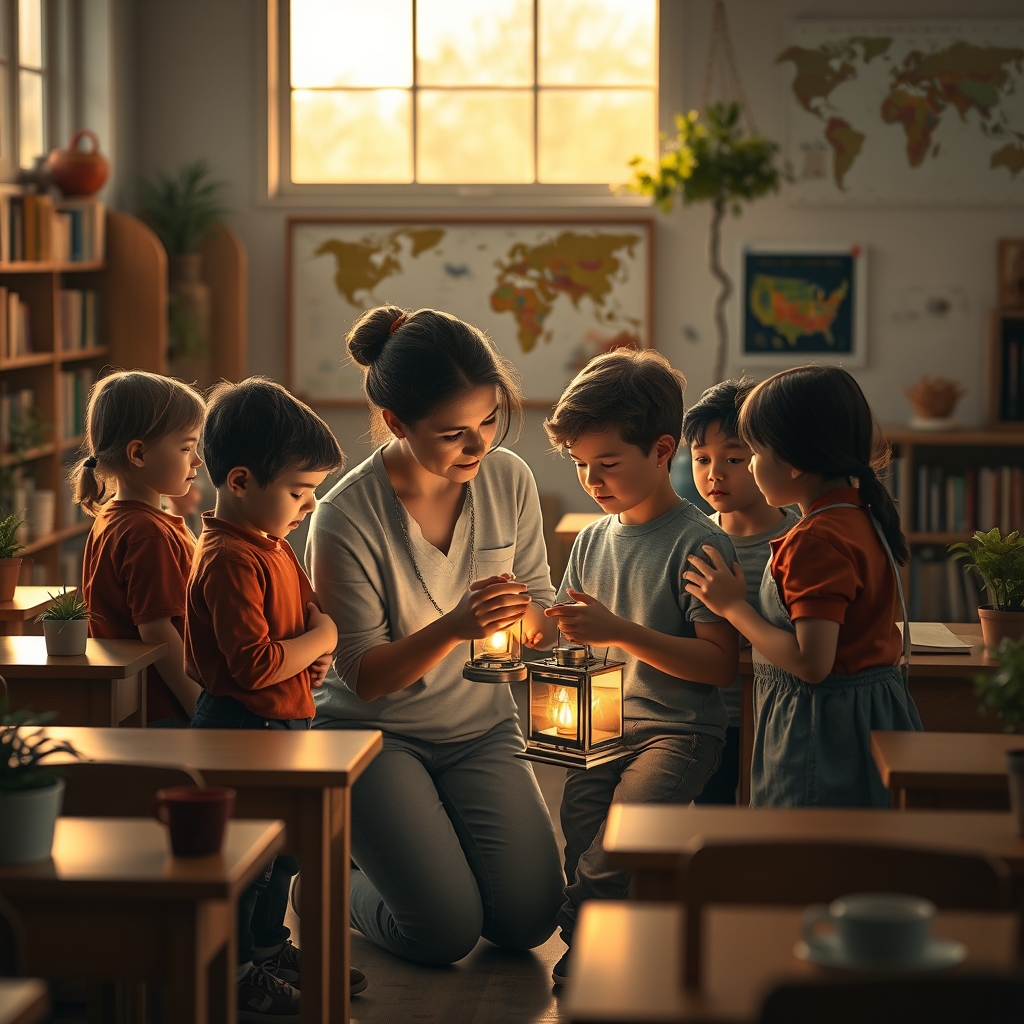
Empathy, in this context, is not merely a soft skill or a pedagogical buzzword. It is the lantern that casts its glow into the recesses of a student’s inner world, revealing the pathways that lead to their truest selves. It is the willingness to sit with a child in their confusion, to listen to the silence between their words, and to recognize that their struggles are not obstacles to be overcome, but signposts pointing toward their unique way of engaging with the world. When a teacher kneels beside a student who is struggling—not to fix, but to witness—they are not just offering support; they are validating the child’s entire existence. In that moment, the classroom becomes more than a place of instruction; it becomes a sanctuary where the soul’s journey is honored as sacred.
The Alchemy of Being Seen
There is an alchemy that occurs when a child feels truly seen. It is as if the weight of invisibility, the burden of being misunderstood or overlooked, dissolves into the air like morning mist. I remember a student—let’s call him Daniel—who spent most of his days in the back of the classroom, his gaze fixed on the window as if searching for something just beyond the horizon. His teachers labeled him “distracted,” “disengaged,” “a daydreamer.” But one afternoon, a substitute teacher sat beside him and asked, not what he was supposed to be learning, but what he was thinking about. Daniel, hesitant at first, began to speak of constellations, of the way the stars seemed to tell stories if you listened closely enough. The substitute didn’t redirect him to the lesson at hand. Instead, she handed him a notebook and said, “Write it down.”
That small act of recognition was the spark that ignited something within him. Daniel didn’t become a model student overnight, but he began to see himself as someone whose thoughts mattered. He started to bring his notebook to class, filling its pages with stories of celestial voyages and mythical creatures. His teachers, initially frustrated by his “lack of focus,” eventually came to understand that his mind was not wandering—it was soaring. And in that realization, they found a way to meet him where he was, rather than where they expected him to be.
The Classroom as a Living Ecosystem
When empathy becomes the foundation of education, the classroom transforms into a living ecosystem, where every student’s unique way of being is not just tolerated, but celebrated. This is not to say that structure or discipline are abandoned. On the contrary, a truly empathetic learning environment requires a delicate balance—one where boundaries are clear, but flexible; where expectations are high, but adaptable; where the curriculum is not a rigid script, but a living dialogue between teacher and student. It is a space where a child who learns through movement is not scolded for fidgeting, but given the freedom to pace the room while reciting their times tables. Where a student who struggles with traditional assessments is offered the chance to demonstrate their understanding through art, or music, or a carefully crafted story.
This kind of education demands something of teachers, too. It requires them to step off the stage and into the role of co-learner, to set aside their assumptions and approach each child with curiosity rather than certainty. It asks them to see their students not as vessels to be filled, but as fires to be kindled. And perhaps most challenging of all, it requires them to confront their own vulnerabilities—the places where their empathy has been worn thin by exhaustion, or where their patience has been tested by the relentless pace of modern education. But in this vulnerability lies the greatest strength, for it is only when a teacher allows themselves to be human that they can truly connect with the humanity of their students.
The Ripple Effect of Small Acts
Empathy in education is not about grand gestures or sweeping reforms. It is about the small, almost imperceptible moments—the way a teacher pauses to ask a student how they’re feeling before diving into a lesson, or the way they remember that a child’s favorite book is about space and bring it to class on a day when the student seems particularly withdrawn. It is in the way a school community rallies around a family going through a difficult time, not with pity, but with quiet solidarity. These acts may seem insignificant in the moment, but their impact ripples outward in ways we can scarcely imagine.
I think of a young girl I once knew, who struggled with anxiety so severe it kept her from speaking in class. Her teachers could have labeled her “shy” or “withdrawn,” but instead, they created a space where her silence was not seen as a deficit, but as a language of its own. They gave her alternative ways to participate—through written responses, through art, through one-on-one conversations where she could take her time to find her voice. It took months, but eventually, she began to speak. Not in grand declarations, but in whispers, in fragments of sentences that grew longer and stronger with each passing day. The day she raised her hand to answer a question for the first time, the entire class held their breath—not out of tension, but out of reverence for the courage it took for her to be seen.
The Lantern’s Glow in the Digital Age
In an era where screens often mediate our interactions, where algorithms curate our learning experiences, and where the pressure to perform can feel relentless, the need for empathy in education has never been more urgent. Technology, when used thoughtfully, can be a powerful tool for personalization—adaptive learning platforms that adjust to a student’s pace, digital portfolios that showcase their growth over time, virtual classrooms that connect learners across continents. But technology alone cannot replace the warmth of a human connection, the quiet understanding that passes between a teacher and student in a shared moment of discovery. The most effective digital classrooms are not those that replace the teacher, but those that amplify their ability to see, to listen, and to respond to the unique needs of each learner.
Yet, even as we embrace the possibilities of tech-enabled education, we must remain vigilant. For every app that promises to “personalize” learning, we must ask: Does it truly see the child behind the data? Does it honor their struggles as much as their successes? Does it leave room for the messy, nonlinear, deeply human process of growth? The most meaningful learning experiences are not those that are perfectly optimized, but those that are deeply human—where mistakes are not failures, but invitations to try again; where questions are not interruptions, but the very heart of the journey.
The soul of education is not found in the accumulation of facts, nor in the mastery of skills, but in the quiet, persistent glow of empathy that lights the way for each child to discover who they are and who they might become. It is in the moments when a teacher sets aside their lesson plan to listen, when a student dares to share their truth, when a classroom becomes a community where every voice is heard. These are the moments that shape not just minds, but hearts—the moments that remind us that education, at its core, is not about preparing children for the future, but about helping them live fully in the present, with all its uncertainties, its challenges, and its infinite possibilities. And perhaps, in the end, that is the most important lesson of all.