The Soul’s Greenhouse: How Sustainable Education Models Nurture the Seeds of Tomorrow’s Minds
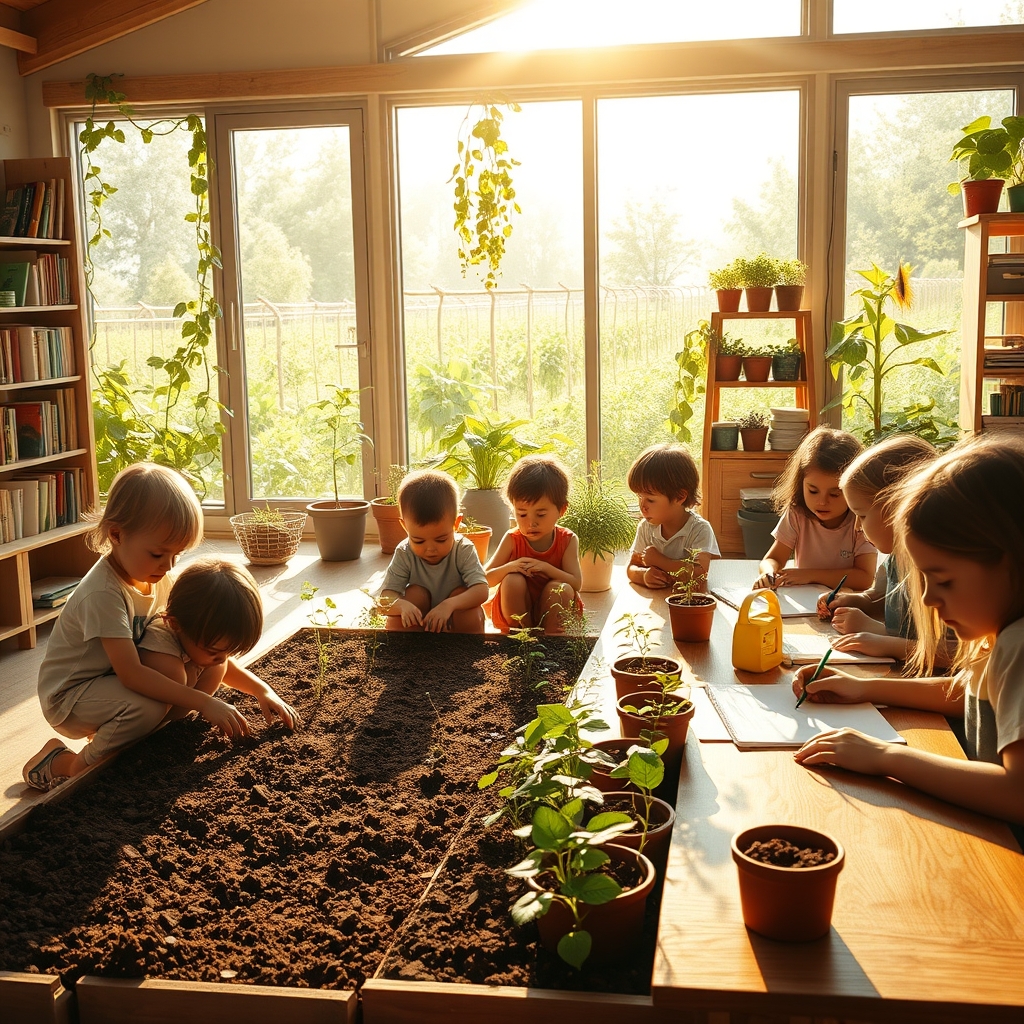
The first time I stepped into a classroom that breathed, I knew something was different. The air hummed with the quiet pulse of life—not just the restless energy of children, but the slow, deliberate rhythm of something deeper, something rooted. There were no rigid rows of desks, no chalk-dusty blackboards dictating the day’s agenda. Instead, sunlight streamed through large windows, pooling onto wooden tables where small hands pressed seeds into soil, where questions sprouted as freely as the basil and mint that curled toward the light. This was not education as I had known it; this was a greenhouse for the soul, where every lesson was a seed, and every child, a gardener of their own becoming.
The Earth as Co-Teacher
In the heart of that sunlit room, the earth itself had become the most patient of instructors. The children learned the weight of water, the stubbornness of weeds, the quiet miracle of a seedling breaking through the dark. They measured growth not in percentages on a report card, but in the height of a sunflower’s stalk, the number of leaves unfurling like tiny green flags of persistence. There was no separation between the curriculum and the world outside—only a porous boundary, where math became the counting of petals, science the alchemy of compost, and history the story of the land beneath their feet. The classroom was not a vessel to be filled, but a living system, where knowledge was not transmitted but cultivated, tended, like the fragile shoots that depended on their care.
I watched as a boy named Eli, who had spent years being told he was “too restless” for traditional learning, knelt in the garden bed, his fingers tracing the veins of a leaf. He was not being disciplined into stillness; he was being invited into wonder. The soil did not demand his compliance—it offered him a role. And in that role, he found something he had never known in a textbook: purpose. The garden did not care if he could sit still for an hour. It cared that he could tell the difference between a ladybug and an aphid, that he could whisper to the plants as if they were old friends. In that moment, he was not a student who struggled; he was a steward of life.
The Alchemy of Adaptive Soil
What makes a greenhouse thrive is not just the warmth of the sun or the richness of the soil, but the attentiveness of the gardener—the way they adjust the conditions for each plant, knowing that what nourishes a tomato may drown a succulent. Sustainable education models operate on the same principle. They recognize that no two minds grow in the same way, that the rigid structures of conventional schooling often force children into molds that do not fit. Instead, these models embrace adaptive strategies, bending like reeds in the wind to meet each learner where they are. A child who struggles with abstract numbers may find their way through the concrete arithmetic of a garden budget. Another, who shuts down under the pressure of timed tests, may bloom when given the time to observe, to sketch, to write poetry about the way a bean plant climbs toward the sky.
This is not about lowering standards; it is about redefining them. The measure of success is not how quickly a child can recite facts, but how deeply they can engage with the world. It is about replacing the assembly line of education with a greenhouse, where every seed is given the space to grow in its own time, in its own way. The soil is not uniform—it is rich with compost, with the decay of old lessons and the nutrients of past failures. And from that fertile ground, something extraordinary emerges: not just knowledge, but wisdom.
The Roots of Community
A greenhouse does not exist in isolation. It is part of a larger ecosystem—dependent on the rain, the bees, the hands that tend it. Similarly, sustainable education models thrive only when they are embedded in a community that values them. Parents are not just spectators but collaborators, bringing their own skills to the garden, whether it’s a grandmother’s knowledge of heirloom seeds or a father’s expertise in building raised beds. Local farmers, artists, and elders become guest teachers, their wisdom woven into the curriculum like vines climbing a trellis. The classroom spills into the neighborhood, and the neighborhood, in turn, becomes the classroom.
I remember a day when the children in that sunlit room decided to sell their harvest at a local market. They calculated prices, designed signs, practiced their pitches. They were not just learning entrepreneurship; they were learning connection. A woman bought a bunch of basil and told them about her grandmother’s pesto recipe. A man asked if they could grow organic carrots next season. The children returned to school not just with coins in their pockets, but with stories, with a sense of belonging to something larger than themselves. That is the power of community-supported learning: it turns education from a solitary pursuit into a shared journey.
The Unseen Harvest
Not all growth is visible. Some of the most important lessons take root in the dark, unseen, unmeasured by tests or grades. A child who learns to care for a plant learns patience. A child who watches a seed sprout learns resilience. A child who tends a garden learns that failure is not the end, but part of the process—some seeds will not germinate, some plants will wither, and that is okay. These are the lessons that do not appear on transcripts, but they shape the soul. They teach children that they are not passive recipients of knowledge, but active participants in the world, capable of nurturing life, of making things grow.
Years later, I wonder how many of those children still carry that greenhouse within them. Do they still kneel in the soil, even if only metaphorically? Do they still see the world as a place of possibility, where every problem is a seed waiting to be tended? I hope so. Because the true harvest of sustainable education is not just the skills it imparts, but the way it changes how we see ourselves and our place in the world. It teaches us that learning is not a race to be won, but a garden to be tended—a lifelong act of cultivation, where the most important thing we can grow is not just knowledge, but the capacity to care, to wonder, to belong.
The greenhouse does not close its doors at the end of the day. It is always there, in the quiet corners of our minds, in the way we pause to watch a bee on a flower, in the way we choose to nurture rather than control. And if we listen closely, we can hear it whispering: You are not just a student. You are a gardener. And the world is waiting for what you will grow.