The Luminous Geography of Belonging: How Every Child’s Inner Landscape Maps the Classroom
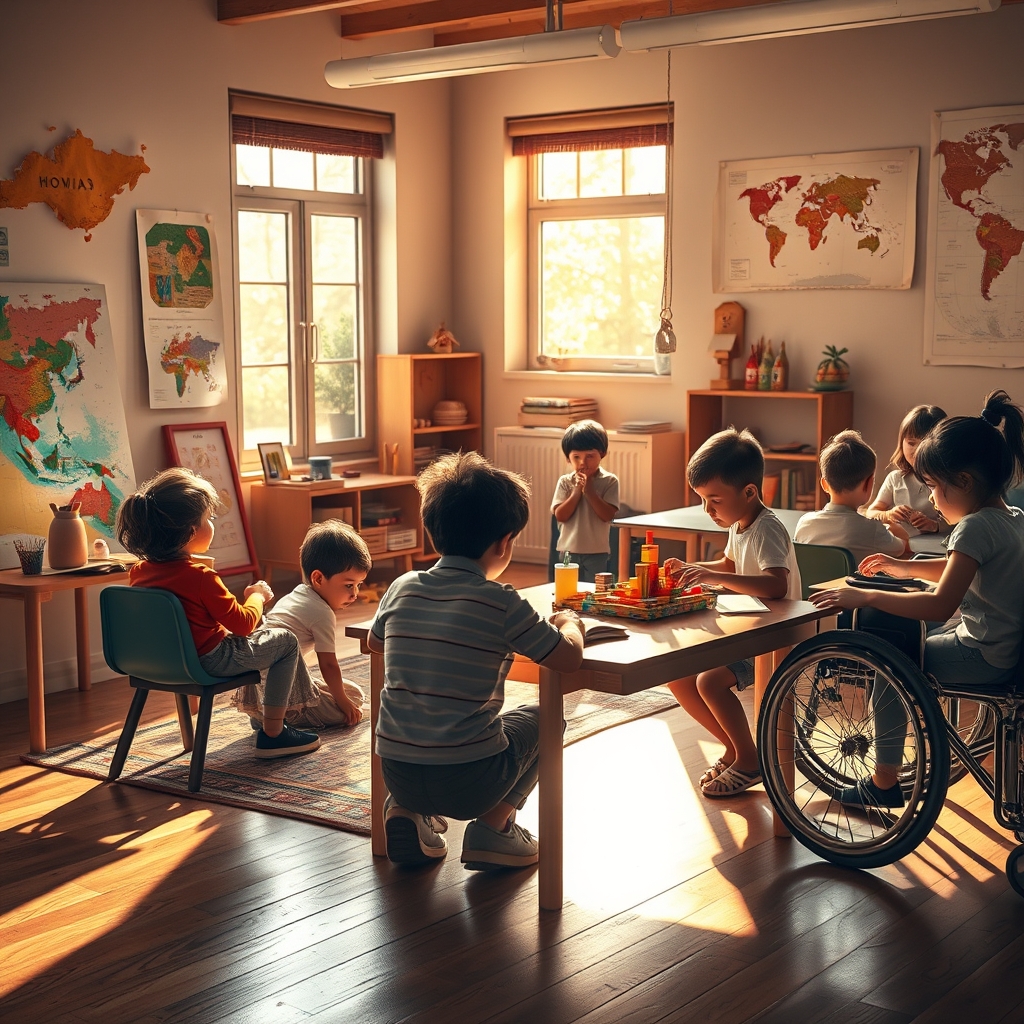
The classroom is not just a room—it is a living atlas, a collection of inner worlds pressed together like pages in an ancient, well-worn book. Each child carries within them a geography of experience: peaks of joy, valleys of doubt, rivers of curiosity, and deserts of silence. To teach is not merely to instruct, but to navigate these landscapes with reverence, to recognize that the terrain of one soul may be vastly different from another, and yet, in the quiet alchemy of inclusion, they can find common ground.
The Cartography of the Heart
There is a map that no standardized test can measure, no curriculum can outline. It is the map of a child’s heart, drawn in invisible ink—lines of resilience, borders of fear, territories of wonder. A child with dyslexia may see words as shifting sands, while another with ADHD perceives time as a river that moves too fast or too slow. A child grieving a loss may carry a storm inside them, while another, neurodivergent and brilliant, may see patterns in the world that others cannot. To teach is to learn the language of these maps, to trace their contours with patience and care.
Educational psychology has long spoken of differentiated instruction, but what does it truly mean to differentiate? It is not just about adjusting assignments or offering alternative assessments—it is about seeing the child before the diagnosis, the person before the label. It is about recognizing that a child who struggles to sit still may be a child who feels the world too deeply, and that a child who speaks in whispers may have a voice that carries farther than we realize.
The Silent Rivers of Emotional Learning
Social-emotional learning is not a checklist; it is a river that flows beneath every lesson, every interaction, every moment of connection or disconnection. When a child raises their hand and stammers an answer, the response they receive—whether a nod of encouragement or a dismissive wave—ripples through their sense of self. When a child is excluded from a game at recess, the wound is not just social; it is a fracture in their belief that they belong.
Character education values are not taught through posters on the wall or scripted lessons on kindness. They are lived in the way a teacher kneels to meet a child’s eyes, in the way a classroom celebrates mistakes as much as successes, in the way a child is given the space to feel, to fail, to try again. The most powerful lessons are not the ones we plan, but the ones that unfold in the unscripted moments—the quiet apology, the shared laughter, the collective breath held before a difficult question is answered.
The Architecture of Inclusion
An inclusive classroom is not built with bricks and mortar, but with intention and presence. It is a space where every child’s story is not just acknowledged but woven into the fabric of the day. Adaptive learning methods are not just tools; they are bridges, spanning the gaps between what a child can do and what they dream of doing. A fidget tool is not a distraction; it is a lifeline. A visual schedule is not a crutch; it is a roadmap. A quiet corner is not a punishment; it is a sanctuary.
Yet, inclusion is not just about accommodations—it is about transformation. It is about shifting the lens through which we see ability, potential, and worth. It is about asking not, What is wrong with this child? but What does this child need to thrive? It is about recognizing that neurodiversity is not a deviation from the norm, but a vital thread in the tapestry of human experience. When we design classrooms with this in mind, we do not just create spaces for learning; we create spaces for belonging.
The Alchemy of Small Gestures
There is a quiet magic in the smallest acts of inclusion. A teacher who remembers how a child takes their coffee in the morning (with exactly two sugars, no cream) is not just being kind—they are saying, I see you. A peer who invites a classmate to join their group, not out of pity but out of genuine connection, is not just being friendly—they are saying, You belong here. A moment of silence after a difficult question is not just a pause—it is an invitation to think, to feel, to be.
These gestures are not grand or performative. They do not require funding or policy changes. They require only presence, attention, and the willingness to see the child in front of you—not as a student to be managed, but as a human to be known. In these moments, the classroom becomes more than a place of instruction; it becomes a sanctuary of recognition.
The Unseen Currents of Equity
Equity in education is not about giving every child the same thing—it is about giving each child what they need to flourish. It is about recognizing that a child who comes to school hungry cannot learn the same way as a child who is well-fed. That a child who has experienced trauma may need more than just academic support—they may need a safe space to land. That a child who speaks a different language at home may need more than just translations—they may need the assurance that their voice matters.
True equity is not a destination; it is a practice. It is the daily choice to see the invisible barriers that children face—the ones that exist in policies, in attitudes, in the unspoken biases that shape our interactions. It is the commitment to dismantle these barriers, not with grand gestures, but with steady, intentional acts of justice. It is the understanding that inclusion is not a program to be implemented, but a way of being in the world.
The classroom, at its best, is a microcosm of the world we wish to create—a world where every child is seen, valued, and given the chance to grow. It is a place where the geography of the heart is not just acknowledged, but celebrated. Where the rivers of emotion are not dammed, but allowed to flow. Where the maps of individual experience are not erased, but honored as essential to the whole. And in this luminous geography of belonging, every child finds their place—not because they fit into a mold, but because the mold was never the point. The point was always the child, in all their messy, beautiful, unique glory.