The Invisible Ink of Curiosity: How a Child’s Questions Write the Story of Their Education
There is a quiet magic in the way a child’s question lingers in the air, unanswered for just a moment too long. It hangs there, fragile as a spider’s thread, catching the light of possibility before it settles into the soil of their mind. What if education were not a series of answers delivered on schedule, but a garden where those questions were allowed to grow wild, untamed by the rigid rows of standardized expectation? What if the true curriculum were not the one printed in textbooks, but the one written in the invisible ink of curiosity, visible only to those who know how to look?
The Alchemy of Wonder
I remember the first time I saw a child’s question transform the classroom. It was not a grand revelation, not a moment of thunderous insight, but something far quieter—a shift in the atmosphere, like the first breath of wind before a storm. A seven-year-old, her brow furrowed in concentration, asked why the sky was blue, not in the way of someone seeking a fact to memorize, but in the way of someone standing at the edge of a vast, unexplored country. The teacher, instead of reaching for the nearest explanation, paused. She knelt beside the child and said, “What do *you* think?” And just like that, the room became a different place. The question was no longer a demand for information, but an invitation to wonder.
That moment was a seed. It did not sprout immediately, but over time, it grew into something far more valuable than a correct answer. It grew into the understanding that learning is not about filling empty vessels, but about kindling the fire that makes them burn. When we treat a child’s questions as sacred, we are not just teaching them facts; we are teaching them how to think, how to feel, how to exist in the world as someone who is alive to its mysteries. This is the alchemy of wonder—the way a simple question can transmute the leaden weight of rote learning into the gold of genuine discovery.
The Architecture of Listening
But wonder cannot thrive in silence. It needs a listener, someone who does not rush to fill the space with answers, but who holds it open, like a cupped hand cradling a fledgling bird. Too often, classrooms are built for speaking, not for listening—for the transmission of knowledge, not the reception of a child’s inner world. We measure success in test scores and benchmarks, but we forget to measure the most important thing of all: the quality of attention we give to the souls in our care.
Listening, real listening, is an act of radical humility. It requires us to set aside our agendas, our lesson plans, our need to be the ones who know. It asks us to trust that the child’s questions are not detours from the path of learning, but the path itself. When a student asks, “Why do people hurt each other?” or “How do birds know where to fly?” they are not just seeking information; they are revealing the contours of their own minds. To answer too quickly is to close a door. To listen, truly listen, is to hold that door open, to let the light spill in.
The Unwritten Syllabus
What would happen if we designed our schools around the unwritten syllabus of a child’s questions? Not as an afterthought, not as a charming diversion from the “real” curriculum, but as the foundation of everything we do? Imagine a classroom where the day begins not with a lecture, but with a question—one that has no single answer, one that invites exploration rather than compliance. Imagine a school where the walls are not barriers, but porous membranes, allowing the world to seep in through the cracks of curiosity.
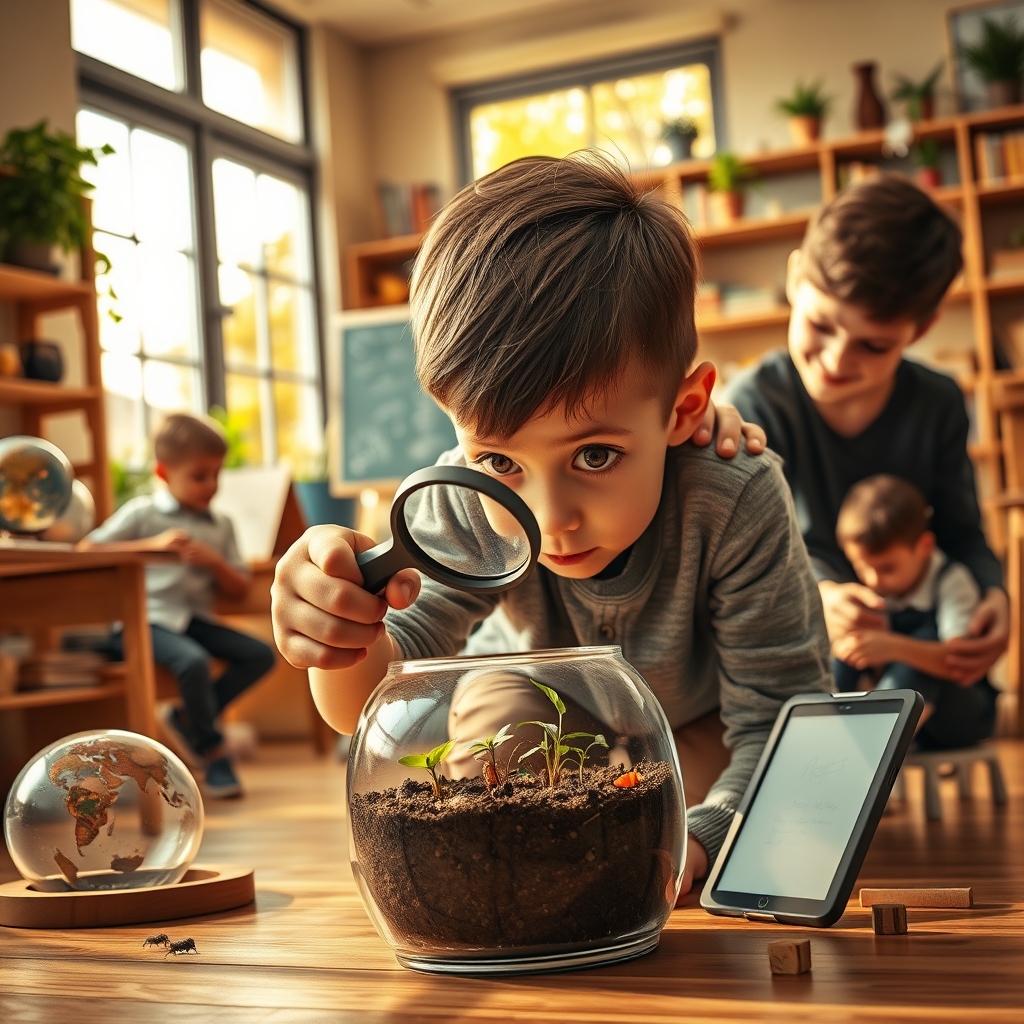
This is not a fantasy. There are places where this is already happening—where teachers are not just instructors, but co-conspirators in the act of discovery. In these spaces, learning is not something that happens *to* children, but something that happens *with* them. The curriculum is not a fixed path, but a living thing, shaped by the questions that arise in the moment. A child’s fascination with ants becomes a study of ecosystems. A question about shadows becomes an exploration of light and perception. The boundaries between subjects dissolve, and what emerges is not a collection of facts, but a way of being in the world—one that is curious, connected, and alive.
The Weight of What We Carry
Yet even in the most progressive classrooms, there is a tension—a pull between the freedom of curiosity and the weight of what we are told education *should* be. We carry the expectations of parents, of administrators, of a system that measures success in narrow, quantifiable terms. We worry that if we let go of control, if we allow the questions to lead the way, we will fail our students. We forget that the greatest failure is not a low test score, but a child who has learned to stop asking questions altogether.
This is the paradox of education: we spend so much time preparing children for the future that we forget to let them live in the present. We drill them on facts and formulas, but we neglect to teach them how to wonder, how to wander, how to get lost in the labyrinth of their own minds. We treat learning as a means to an end, rather than an end in itself. And in doing so, we risk extinguishing the very spark that makes education worth pursuing.
The Geography of the Mind
Every child’s mind is a landscape, vast and uncharted. Some are deserts, where questions bloom like cacti after a rare rain. Others are forests, dense with thoughts that twist and turn like vines. Still others are oceans, their depths hiding currents of curiosity we may never fully understand. To teach is not to impose a map upon these landscapes, but to help children navigate them for themselves. It is to provide them with the tools they need to explore—to ask, to seek, to stumble, to find their way back when they get lost.
This is the work of a lifetime. It does not happen in a single lesson, or even in a single year. It happens in the accumulation of moments—the way a teacher’s pause can make a question feel sacred, the way a student’s eyes can light up when they realize their thoughts matter, the way a classroom can become a place where curiosity is not just allowed, but celebrated. These are the moments that write the true story of a child’s education, not in ink, but in the invisible script of their soul.
The most beautiful thing about a child’s questions is that they are never really answered. They are not meant to be. They are meant to linger, to echo, to evolve into new questions, new explorations, new ways of seeing the world. They are the threads that weave the tapestry of a life lived in wonder. And if we are lucky, if we listen closely enough, they will weave us into that tapestry too, reminding us that the purpose of education is not to fill minds, but to set them on fire.