
The Algorithmic Overlords: Or, How Adaptive Learning Became Education’s Latest Digital Panacea
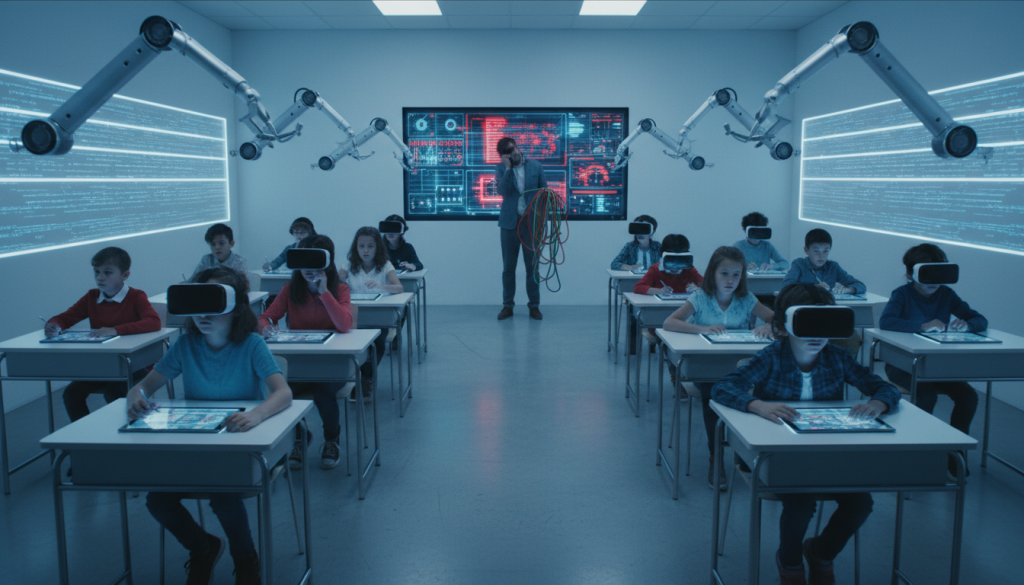
Ah, “adaptive learning.” The phrase itself whispers promises of tailored instruction, personalized pathways, and the glorious eradication of the one-size-fits-all classroom. It’s the educational equivalent of a bespoke suit, except instead of a master tailor, you get an algorithm. And instead of fine wool, you often get a series of multiple-choice questions that magically “adapt” to your child’s unique genius by serving up more of the same, just at a slightly different pace. It’s the future, they say, and who are we mere mortals to question the digital deities guiding our children’s intellectual destiny?
The Myth of Perfect Personalization: A Digital Dream Sequence
The sales pitch is always dazzling: imagine a world where every student receives exactly what they need, when they need it. No more bored prodigies, no more struggling learners left behind. Adaptive learning platforms, powered by the mystical forces of artificial intelligence and machine learning, promise to be the ultimate tutor, the tireless differentiator, the all-knowing pedagogical oracle. They collect data, they analyze patterns, they adjust the curriculum on the fly, transforming education from a clunky, human-centric endeavor into a sleek, data-driven experience. What could possibly go wrong when we outsource intellectual curiosity to a server farm?
In reality, this often translates to a student spending an inordinate amount of time interacting with a screen, clicking through modules that feel suspiciously like glorified digital worksheets. The “adaptation” frequently means if you struggle with fractions, you get more fractions. If you excel, you get more advanced fractions. It’s less like a personalized journey through the vast landscape of knowledge and more like being stuck on a particularly persistent treadmill, with the speed adjusted by an unseen hand that sometimes feels more arbitrary than intelligent. The human element, the spontaneous tangent, the insightful digression – these are messy, inefficient variables that algorithms tend to frown upon.
The Teacher: From Sage on the Stage to IT Support on the Side
One of the grand selling points of adaptive learning is that it “frees up” teachers. Free up for what, precisely? To gaze wistfully out the window while their digital overlords handle the heavy lifting? The reality on the ground is far less idyllic. Instead of engaging in rich, meaningful instruction, teachers often find themselves wrestling with login issues, deciphering opaque data dashboards, and playing tech support for a classroom full of frustrated users. The “insights” provided by these platforms can be so granular they’re practically microscopic, or so generalized they’re utterly useless, leaving educators to wonder if they’re teaching children or merely monitoring algorithmically generated progress bars.
The art of teaching – the subtle cues, the encouraging word, the ability to pivot based on a student’s non-verbal communication – becomes secondary to ensuring the software is running smoothly and that every student is logged in and “on task.” The precious time that was supposed to be liberated for deeper engagement is often swallowed by administrative overhead, troubleshooting glitches, and trying to reconcile the platform’s assessment with the actual, breathing child sitting in front of them. It’s a marvelous trick: selling a solution that purports to simplify, only to introduce a whole new layer of complexity and digital bureaucracy.
The Illusion of Equity: Bridging Gaps with a Digital Divide
Adaptive learning is often championed as a great equalizer, promising to deliver high-quality, personalized instruction to every student, regardless of their background or previous learning experiences. It’s supposed to bridge achievement gaps and ensure equity in education. A noble goal, indeed. However, the path to digital nirvana is paved with good intentions and often overlooks some rather inconvenient truths.
Not every student has reliable internet access at home. Not every family can afford a dedicated device. Not every child possesses the digital literacy skills to navigate complex platforms independently. And even if they do, the very algorithms designed to “adapt” can sometimes inadvertently reinforce existing biases or learning pathways, offering a narrower, rather than broader, educational experience for students who deviate from the perceived norm. True equity requires more than just access to software; it demands human connection, cultural understanding, and resources that extend beyond a glowing screen.
The Perpetual Beta of Education: An Endless Upgrade Cycle
Like all good technological solutions, adaptive learning platforms are never truly finished. They are in a perpetual state of “beta,” constantly evolving, demanding new updates, new training modules for teachers, and, of course, new subscription fees. The educational landscape becomes a dizzying carousel of the “next big thing,” each promising to finally crack the code of learning, only to be supplanted by an even newer, shinier algorithm a few years down the line. It’s a lucrative business, selling the promise of efficiency and personalization, often at the expense of genuine pedagogical innovation and the invaluable human interaction that defines true teaching and learning.
Perhaps, amidst all the data points and algorithms, we might remember that education, at its heart, is a deeply human endeavor. It thrives on curiosity, conversation, and connection, not just on perfectly optimized learning paths. While technology certainly has its place, mistaking a sophisticated digital tool for the entirety of teaching and learning might just be the most un-adaptive approach of all, leaving us with students who are expertly trained by machines, but perhaps less adept at navigating the beautiful, messy, and utterly unpredictable world outside the screen.