The Alchemy of Attention: How the Smallest Gestures Forge the Greatest Inclusion
There is a quiet magic in the way a teacher’s gaze lingers just a second longer on the student who hesitates before answering, in the way a handwritten note appears on a desk when the rest of the class is distracted by the hum of fluorescent lights. These are not grand gestures—no fanfare, no policy shift announced in a staff meeting—but they are the alchemy of attention, the subtle transmutation of ordinary moments into something sacred: the feeling of being seen. Inclusive education is not merely a framework of strategies or a checklist of accommodations; it is an art of noticing, a practice of honoring the invisible threads that connect each learner to the collective tapestry of the classroom.
The Myth of the Monolith
We speak often of “the classroom” as if it were a single entity, a uniform space where learning unfolds in predictable rhythms. But the truth is far more fragmented, far more human. A classroom is a constellation of souls, each orbiting their own center of gravity—some pulled by the weight of anxiety, others buoyed by the lightness of curiosity, a few caught in the undertow of trauma or the stillness of unmet needs. To teach inclusively is to recognize that no two learners are traveling the same path, even if they share the same room, the same curriculum, the same teacher’s voice.
Differentiated instruction is often framed as a Herculean task, a mountain of planning and prep work that leaves teachers gasping for breath. But what if we reframed it not as a burden, but as an act of devotion? The student who needs the text read aloud, the one who requires movement breaks, the child who thrives in silence—these are not problems to be solved, but invitations to deepen our own humanity. The myth of the monolith crumbles when we acknowledge that fairness is not sameness, but the courage to meet each learner where they are, even if it means bending the rules we once held sacred.
The Unspoken Curriculum
Beyond the lessons of math and history, there is another curriculum at work in every classroom: the unspoken one. It is the curriculum of belonging, of emotional safety, of the quiet understanding that mistakes are not failures but stepping stones. Social-emotional learning is often reduced to a series of scripts or worksheets, but its true power lies in the unscripted moments—the way a teacher models vulnerability by admitting when they don’t know the answer, or the way a classroom community rallies around a student who is having a hard day. These moments are not measurable, but they are the bedrock of inclusion.
Character education, too, is often distilled into a list of virtues to be memorized and recited. But morality is not a multiple-choice test; it is a lived experience. It is the student who learns empathy not from a poster on the wall, but from the way their classmate’s face lights up when they finally understand a concept. It is the teacher who demonstrates integrity not by preaching about honesty, but by admitting when they’ve made a mistake and making it right. The unspoken curriculum is where the real work of education happens, in the spaces between the lessons, in the glances and the pauses and the unguarded moments of connection.
The Weight of the Individualized Plan
There is a certain gravity to the Individualized Education Plan (IEP), a document that carries the weight of a child’s potential within its bureaucratic folds. It is easy to see it as a contract, a set of benchmarks to be met, a roadmap to compliance. But what if we saw it instead as a love letter? A testament to the belief that every child deserves a path tailored to their unique strengths, a promise that their needs will not be an afterthought but a priority. The IEP is not a checklist; it is a covenant between the school, the child, and the future.
Yet, the reality is often far messier. The IEP meeting can feel like a performance, a carefully choreographed dance where parents, teachers, and administrators navigate the delicate balance between hope and realism. There is a tension in these rooms, a silent negotiation between what is ideal and what is possible. But within that tension lies the heart of inclusive education: the recognition that every child is worth the effort, even when the system is not designed to make it easy. The IEP is not just a plan; it is a rebellion against the idea that some children are too difficult, too different, too much.
The Classroom as a Living Organism
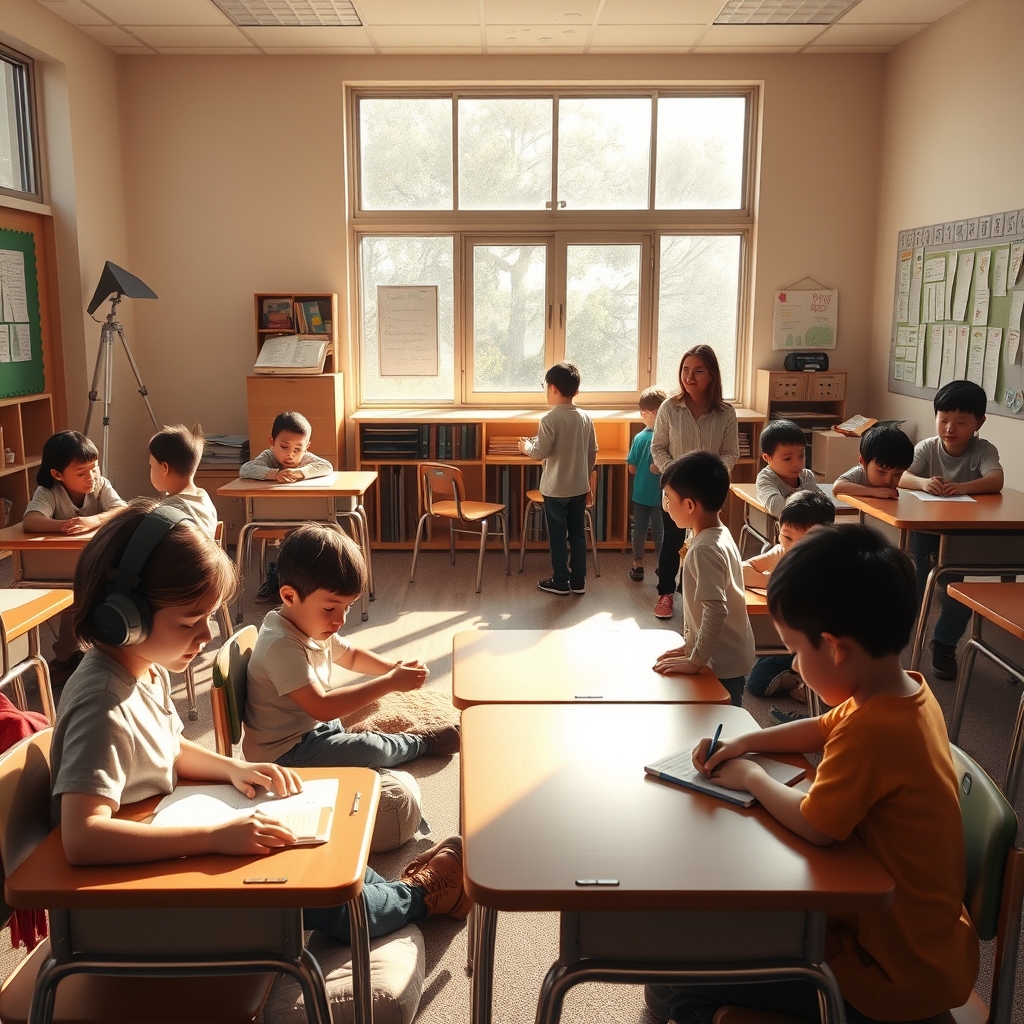
An inclusive classroom is not a static space; it is a living, breathing organism, constantly evolving in response to the needs of its inhabitants. It is the teacher who rearranges the desks to create a quiet corner for the student who needs a break from sensory overload. It is the student who notices a classmate struggling and offers to explain a concept in a different way. It is the moment when a child who has never spoken in class raises their hand, and the room holds its breath in anticipation. These are the small revolutions that happen every day, the quiet uprisings of empathy and understanding.
Neurodiversity awareness is not just about recognizing the spectrum of cognitive differences; it is about celebrating them. It is about seeing the child who stims as not just a behavior to be managed, but a person whose way of moving through the world is as valid as any other. It is about understanding that the student who struggles with reading may have a gift for spatial reasoning, or that the child who cannot sit still may have an unparalleled ability to think outside the box. The inclusive classroom is not a place where differences are erased, but where they are honored as essential threads in the fabric of the community.
The Teacher as Alchemist
Teachers are not just instructors; they are alchemists, transforming the base metals of curriculum and policy into the gold of human connection. Professional development often focuses on strategies and techniques, but the most powerful tool a teacher has is their own presence. It is the ability to listen not just to the words a student says, but to the ones they cannot find. It is the willingness to sit with discomfort, to hold space for a child’s frustration or fear without rushing to fix it. It is the quiet act of bearing witness to a student’s journey, of saying, without words, “I see you, and you matter.”
This is not to romanticize the work of teaching. The reality is that inclusive education is hard. It requires patience, creativity, and a willingness to fail and try again. It demands that teachers confront their own biases, their own limitations, their own exhaustion. But within that struggle lies the beauty of the work: the knowledge that every small act of inclusion is a ripple that extends far beyond the classroom, shaping not just the lives of individual students, but the very fabric of society.
The alchemy of attention is not found in grand gestures or sweeping reforms, but in the quiet, daily acts of noticing. It is in the way a teacher remembers how a student takes their coffee, or the way they pause to ask about a child’s weekend. It is in the way a classroom is designed not just for efficiency, but for humanity—with soft lighting, flexible seating, and spaces for both collaboration and solitude. These are the small things that add up to something profound: the feeling of being known, of being valued, of belonging. And in the end, that is what inclusive education is all about—not just teaching students, but reminding them that they are not alone in this world, that their stories are worth telling, and that their presence matters, exactly as they are.