The Soul’s Prism: How the Light of Adaptive Education Refracts the Hidden Spectrum of a Child’s Potential

There is a quiet magic in the way a child’s mind unfolds—not in broad, sweeping strokes, but in delicate, shifting hues, like sunlight filtering through a prism. Each beam bends differently, revealing a spectrum of possibilities that were always there, waiting to be seen. This is the essence of adaptive education: the understanding that no two learners refract the light of knowledge in quite the same way. It is not merely about adjusting lessons or pacing; it is about honoring the unique geometry of a child’s inner world, where curiosity bends and curiosity breaks, where some ideas take root in an instant while others require the slow, patient nurturing of time.
The Alchemy of Attention
In a classroom where the curriculum breathes with the rhythm of its students, something extraordinary happens. The rigid lines between teacher and learner soften, and the act of education becomes less about transmission and more about co-creation. A child who struggles with numbers may find solace in the patterns of music, where fractions become melodies and equations transform into rhythms. Another, who stumbles over words on a page, might discover their voice in the vivid storytelling of digital media, where images and text dance together in a language all their own. Adaptive education does not ask a child to conform to the shape of a lesson; it reshapes the lesson to fit the contours of the child.
This is not a surrender to chaos, but a deeper kind of order—one that recognizes that the mind is not a vessel to be filled, but a fire to be kindled. The most profound learning often happens in the spaces between the expected, where a question lingers unanswered just long enough to spark another, and another, until the child is no longer following a path but blazing one of their own. The teacher, then, is not a gatekeeper of knowledge but a guide who knows when to step forward and when to step back, when to offer a steadying hand and when to let the wind carry the learner just a little further than they thought they could go.
The Geography of Growth
Imagine a classroom where the walls are not barriers but horizons, where every child’s journey is mapped not by standardized milestones but by the unique topography of their own development. Some will climb steep peaks early, their minds scaling the heights of abstract thought with ease, while others will wander through valleys rich with sensory detail, where learning is tactile, immersive, and deeply personal. Adaptive education does not measure progress in straight lines but in the intricate, meandering paths that reveal the true shape of a child’s potential.
This kind of learning requires a different kind of vision—one that sees beyond the immediate and into the possible. It asks educators to become cartographers of the unseen, tracing the invisible contours of a child’s strengths, passions, and even their struggles, which often hold the seeds of their greatest growth. A student who resists traditional instruction may not be defiant but simply waiting for the right key to unlock their understanding. Perhaps that key is a project that ties their love of nature to the principles of physics, or a collaborative task that allows them to lead in ways that feel authentic to them. The magic lies in the moment when the child realizes that their way of learning is not a flaw but a feature—a unique lens through which the world becomes clearer, brighter, more vivid.
The Echoes of Empathy
At the heart of adaptive education is empathy—not as a soft skill, but as a radical act of seeing. It is the quiet recognition that a child’s struggles are not failures but signposts, pointing toward the kind of support they need to thrive. It is the willingness to listen not just to what a child says, but to what they do not say, to the hesitations in their voice, the spark in their eyes when a subject ignites their curiosity, the way their body relaxes when they finally feel understood. This kind of empathy does not dilute rigor; it deepens it, because it understands that true mastery is not about speed or uniformity, but about the depth of a child’s engagement with the world.
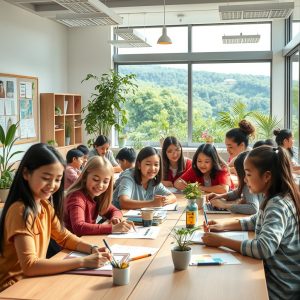
When a classroom is built on this foundation, something shifts. The air hums with a different kind of energy—not the anxious buzz of competition, but the steady, resonant pulse of collaboration. Children begin to see their peers not as rivals but as fellow travelers, each with their own strengths and struggles, their own ways of refracting the light. They learn to ask for help not as a last resort, but as a natural part of the journey, and to offer it not as charity, but as a gift. In this space, mistakes are not stumbles but stepping stones, and every question is a door waiting to be opened.
The Unseen Threads of Tomorrow
What does it mean to prepare a child for a future we cannot yet see? The world is changing at a pace that defies prediction, and the skills that will serve them best are not those that can be memorized and regurgitated, but those that allow them to adapt, to innovate, to connect. Adaptive education is not just about meeting children where they are; it is about equipping them to meet the unknown with confidence, curiosity, and resilience. It teaches them that their minds are not fixed but fluid, capable of growth and transformation, and that the most important lessons are not the ones they absorb passively, but the ones they discover for themselves.
The beauty of this approach lies in its quiet revolution. It does not shout its presence but reveals itself in the small, everyday moments—the child who finally grasps a concept that once eluded them, not because they were forced to, but because it was presented in a way that resonated with their unique way of thinking; the student who finds their voice in a project that allows them to explore their passions; the classroom where every child feels seen, not in spite of their differences, but because of them. These are the threads that weave the fabric of a future where education is not a one-size-fits-all endeavor, but a vibrant, ever-evolving tapestry of human potential.
And so, the prism turns, and the light bends anew, casting its spectrum across the landscape of learning. Each child who steps into the glow of adaptive education carries within them a universe of possibilities, waiting to be revealed. The role of the educator, then, is not to dictate the shape of that universe, but to hold the prism steady, to let the light pour in, and to watch in wonder as the child’s potential unfolds in colors no one else could have imagined.