The Luminous Thread: How Tailored Academic Pathways Weave the Soul of a Learner
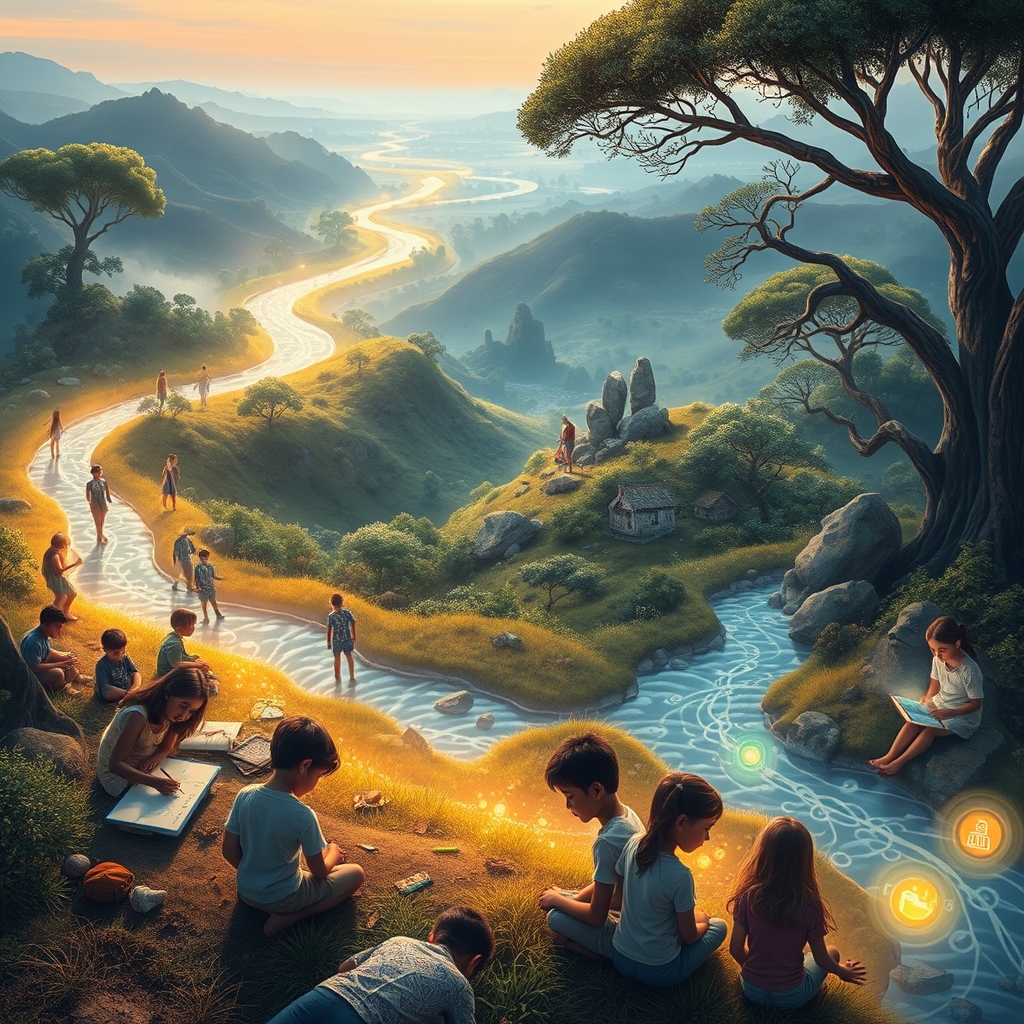
There is a quiet magic in the moment a child realizes the world is not a monolith of expectations, but a vast, shimmering tapestry of possibilities—each thread unique, each path their own to claim. It is the moment when education ceases to be a rigid ladder and becomes instead a river, winding and wide, carrying them not toward some distant, predetermined shore, but deeper into the currents of their own curiosity. This is the promise of tailored academic pathways: not just a method, but a philosophy that honors the soul of the learner as much as the mind.
The Alchemy of Individuality
We have long measured education in standardized increments—grades, test scores, benchmarks—each one a brick in the wall of conformity. But what if the true measure of learning is not how well a child fits into the mold, but how boldly they reshape it? Tailored academic pathways do not ask students to shrink themselves to fit the system; they ask the system to expand, to bend, to wrap itself around the contours of each child’s strengths, passions, and pace. It is an alchemy of sorts, turning the base metal of rigid curricula into the gold of personalized discovery.
Consider the student who struggles with traditional math but lights up when calculating the angles of a skateboard ramp. Or the child who zones out during history lectures but loses hours in the library, tracing the footsteps of ancient explorers through dusty maps. These are not deficits to be corrected; they are invitations to reimagine what learning can be. When education becomes a mirror rather than a mold, children begin to see themselves not as vessels to be filled, but as artists, shaping their own intellectual landscapes.
The River and the Shore
There is a tension in education between the river and the shore—the fluid, ever-changing nature of a child’s growth and the fixed landmarks we use to measure it. Traditional schooling often prioritizes the shore, mapping progress in neat, linear increments. But rivers do not flow in straight lines. They meander, they flood, they carve new paths through the earth. Tailored academic pathways embrace this fluidity, allowing students to explore the tributaries of their interests, to linger where the current is richest, to rush forward when the rapids of inspiration call.
This is not to say there are no shores at all. Even the most meandering river has banks that guide its flow. The difference is that in a tailored system, those banks are not rigid walls but flexible boundaries, shifting to accommodate the natural course of a child’s learning. A student might dive deep into marine biology one semester, only to emerge the next with a passion for poetry inspired by the ocean’s rhythms. The pathway does not demand they choose one or the other; it invites them to weave the two together, to see how knowledge is not siloed but interconnected, like the roots of a great tree.
The Collaborative Tapestry
Tailored academic pathways are not solitary journeys. They are woven in collaboration—with teachers who act as guides rather than gatekeepers, with peers who bring their own threads to the tapestry, with communities that offer real-world contexts for learning. In a classroom where pathways are personalized, the air hums with a different kind of energy. It is not the quiet compliance of rows of desks, but the vibrant hum of engagement, of students leaning into their work not because they have to, but because they are hungry to.
This is where the magic of collaborative learning environments comes alive. When a student’s pathway intersects with another’s, something extraordinary happens. A project on climate change becomes a dialogue between a budding scientist and a young poet, each bringing their unique lens to the work. A history assignment evolves into a debate between a student fascinated by military strategy and another drawn to the stories of civilians caught in the crossfire. The classroom becomes a microcosm of the world, a place where differences are not just tolerated but celebrated as essential to the learning process.
The Weight of the Unseen
Yet for all its luminosity, the path of tailored learning is not without its shadows. There is the weight of the unseen—the quiet struggles of a child who feels adrift without the familiar structure of traditional schooling, the parent who worries their child is “falling behind” because their journey doesn’t look like the one next door. There is the challenge of equity, of ensuring that every child, regardless of background, has access to the resources and support they need to carve their own path.
But these shadows do not diminish the light; they deepen it. They remind us that tailored pathways are not about abandoning structure, but about redefining it. They are not about leaving children to navigate alone, but about equipping them with the compass of self-awareness, the map of their own strengths, and the tools to ask for help when the way forward is unclear. The goal is not to create a generation of lone wolves, but of resilient, self-aware learners who know how to seek out the guidance they need, whether from a teacher, a peer, or the quiet voice within.
The Soul’s Curriculum
At its heart, the philosophy of tailored academic pathways is a recognition that education is not just about preparing children for the future, but about helping them live fully in the present. It is about honoring the fact that a child’s curiosity is not a distraction from learning, but the very engine of it. When we allow students to follow the threads of their interests, we are not just teaching them facts; we are teaching them how to think, how to question, how to connect the dots of their own lives in ways that are meaningful to them.
This is the soul’s curriculum—the quiet, often unseen work of helping a child discover who they are and who they might become. It is the work of holding space for their questions, even when those questions do not have easy answers. It is the work of trusting that the detours, the pauses, the moments of struggle are not deviations from the path, but the path itself. And it is the work of believing that when a child is given the freedom to learn in a way that resonates with their own spirit, they will not just succeed—they will flourish.
Perhaps the most beautiful thing about tailored academic pathways is that they do not just change how children learn; they change how they see themselves. When a child is no longer a passive recipient of knowledge but an active participant in their own education, something shifts. They begin to see their mind not as a vessel to be filled, but as a flame to be tended. They begin to understand that their voice matters, that their questions are valid, that their unique way of seeing the world is not a flaw to be corrected, but a gift to be shared. And in that moment, the classroom ceases to be a place of instruction and becomes instead a place of transformation—a place where the luminous thread of their potential is not just seen, but set free to weave its own way through the world.