The Alchemy of Attention: How Customized Educational Support Transforms the Lead of Struggle into the Gold of Discovery
There is a quiet magic in the moment when a child’s eyes light up—not with the fleeting spark of amusement, but with the slow, steady glow of understanding. It is the kind of light that does not flicker under the weight of doubt or dim in the face of challenge. It is the luminescence of a mind that has been met where it stands, not where the curriculum dictates it should be. This is the alchemy of attention, the transformative power of customized educational support, where struggle is not a sign of failure but the raw material from which discovery is forged.
The Unseen Architecture of the Mind
Every child carries within them an unseen architecture, a labyrinth of synapses and synapses, of memories half-remembered and questions not yet asked. Traditional education often treats this inner landscape as a uniform terrain, a one-size-fits-all path where every student is expected to march in lockstep. But what happens when the path is too narrow for some, too wide for others? What becomes of the child who stumbles not because they lack ability, but because the ground beneath them was never meant to hold their particular shape?
Customized educational support is not about lowering standards or coddling minds. It is about recognizing that the mind, like a river, carves its own course. Some children need the gentle slope of scaffolding to ascend a concept; others require the sharp drop of a challenge to feel the thrill of the climb. The alchemy lies in the teacher’s ability to read the landscape of each student’s mind, to know when to offer a hand and when to step back and let the current carry them forward.
The Quiet Rebellion of Responsive Curriculum
There is a quiet rebellion in designing a curriculum that bends rather than breaks. Responsive curriculum design is not a surrender to chaos; it is an acknowledgment that learning is not linear. It is a dance, a back-and-forth between the known and the unknown, between the comfort of familiarity and the exhilaration of the new. When a teacher adjusts the pace, shifts the focus, or introduces a new lens through which to view a problem, they are not disrupting the order of the classroom—they are honoring the natural rhythm of discovery.
Consider the child who struggles with numbers but thrives in storytelling. A responsive curriculum might weave mathematics into the fabric of narrative, turning word problems into tales of adventure where the hero must solve a riddle to unlock the next chapter. Suddenly, the abstract becomes tangible, the daunting becomes engaging. This is not a workaround; it is a reimagining of what learning can be when it is allowed to breathe, to adapt, to become something greater than the sum of its parts.
The Soul’s Compass: Navigating Tailored Academic Pathways
There is a compass within each of us, a silent guide that points not to true north, but to the truest version of ourselves. Tailored academic pathways are the trails blazed by this inner compass, routes that honor the unique topography of a child’s strengths, passions, and potential. These pathways are not detours from the main road; they are the main road, the one that leads to a destination far more meaningful than a standardized test score.
When a student is given the freedom to explore subjects that resonate with their soul, something extraordinary happens. The mind becomes a garden, and curiosity the rain that nourishes it. A child who loves the stars might delve into astrophysics through the lens of mythology, tracing the constellations of ancient stories to the equations that govern their movements. Another might find their calling in the quiet precision of coding, where logic and creativity intertwine like the threads of a tapestry. These are not just academic pursuits; they are the first steps on a journey of self-discovery, where the destination is not a grade, but a deeper understanding of who they are and what they are capable of becoming.
The Echoes of Empathy in the Classroom
Empathy is the silent architect of customized educational support. It is the ability to see beyond the surface—to recognize that the child who acts out in class is not defiant, but drowning in frustration; that the one who sits quietly in the corner is not disinterested, but lost in a world of their own making. Empathy-driven schooling is not about pity or leniency; it is about seeing the child as they truly are, not as they appear in the moment.
When a teacher approaches a student with empathy, they are not just teaching a lesson; they are building a bridge. They are saying, without words, I see you. I understand. You are not alone. This is the foundation upon which all learning is built, the unshakable belief that every child deserves the chance to be seen, to be heard, to be understood. It is the difference between a classroom that feels like a factory and one that feels like a home.
The Fragile Balance of Tech and Touch
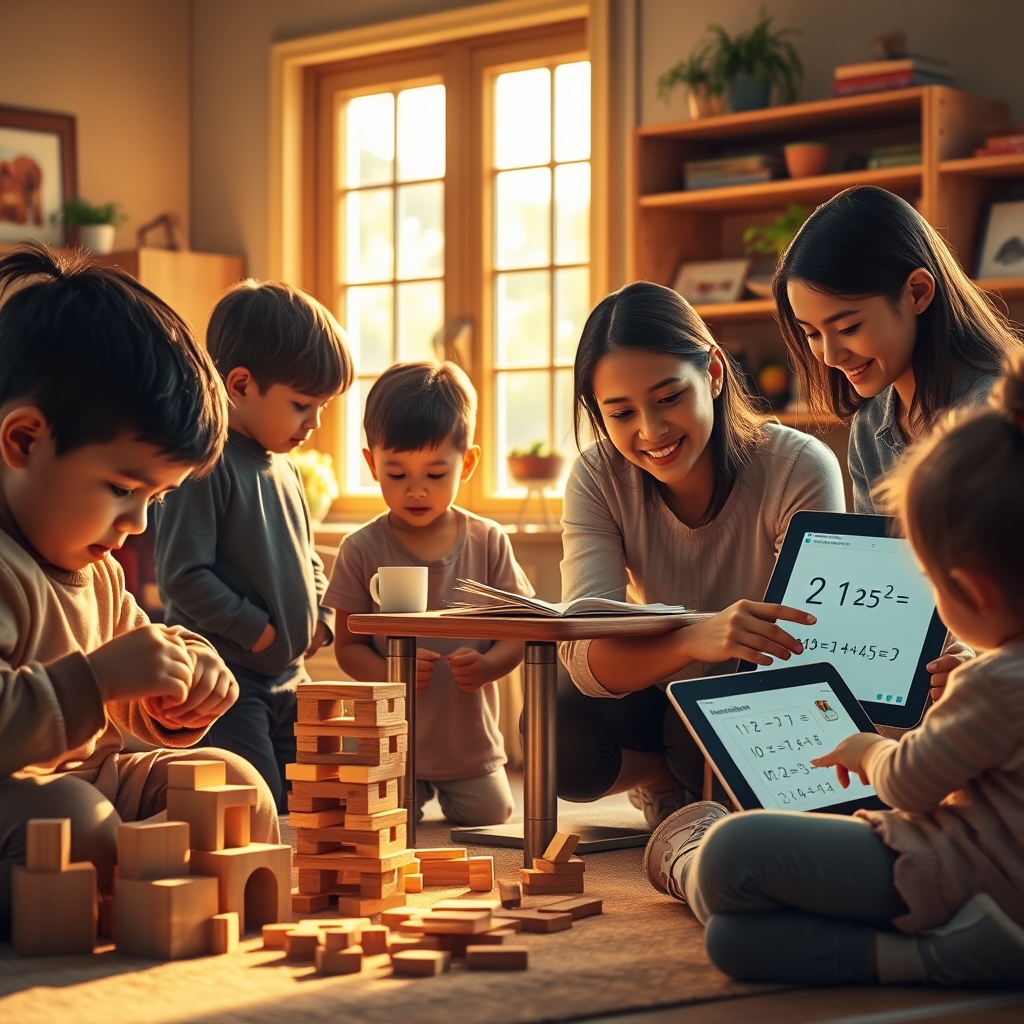
In an age where screens mediate so much of our interaction, the integration of digital tools into education is both a blessing and a challenge. Tech-enabled early education can open doors that were once locked, offering simulations of distant lands, instant access to the collective wisdom of humanity, and adaptive platforms that meet students at their level. But technology, no matter how advanced, is only as powerful as the hands that wield it.
The true magic of digital classroom integration lies not in the tools themselves, but in how they are used to deepen human connection. A tablet can deliver a personalized lesson, but it cannot offer the warmth of a teacher’s smile when a student finally grasps a concept. An adaptive learning program can adjust the difficulty of a task, but it cannot celebrate a child’s progress with the same joy as a mentor who has walked beside them. The alchemy of attention requires both the precision of technology and the warmth of human touch, a balance that ensures no child is left behind in the digital divide.
The Unwritten Promise of Real-World Skill Acquisition
Education is often measured by what can be quantified—test scores, grades, graduation rates. But the most valuable lessons are those that cannot be captured on a report card. Real-world skill acquisition is the unwritten promise of a student-centric education, the quiet confidence that comes from knowing how to navigate the complexities of life beyond the classroom. It is the ability to collaborate, to communicate, to think critically, to adapt. These are the skills that turn knowledge into wisdom, that transform a student into a lifelong learner.
Project-based learning is one of the most powerful ways to cultivate these skills. When students work together to solve a real-world problem—designing a community garden, creating a business plan, or developing a campaign to address a social issue—they are not just applying what they have learned. They are discovering who they are in relation to the world around them. They are learning that their voice matters, that their ideas have value, that they are capable of making a difference. This is the gold that customized educational support seeks to uncover, the treasure hidden within every child, waiting to be revealed.
The alchemy of attention is not a one-time transformation, but a lifelong process. It is the quiet, steady work of meeting each child where they are, of seeing the potential in their struggles, of believing in their ability to rise. It is the art of turning the lead of doubt into the gold of discovery, not through magic, but through the patient, persistent power of being truly seen. And in that seeing, in that quiet acknowledgment of another soul’s journey, lies the true heart of education—not as a system, but as a sacred act of human connection.