
The Quiet Rebellion: How the Smallest Acts of Defiance Build an Inclusive Classroom
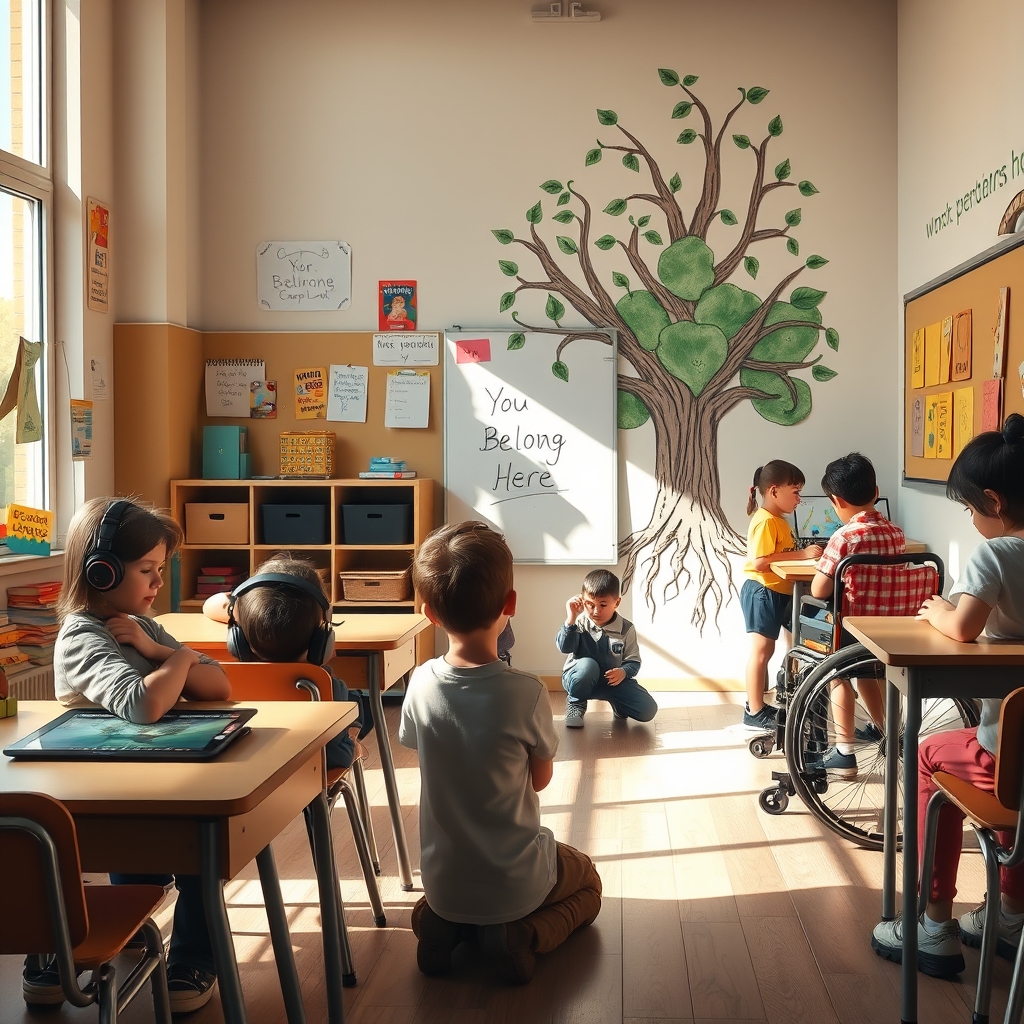
There is a kind of rebellion that does not announce itself with raised fists or shouted slogans. It does not demand attention, nor does it seek the spotlight. Instead, it moves quietly, like the turning of a page in a book no one else is reading, or the soft placement of a chair just a little closer to the child who always sits alone. This is the rebellion of the inclusive classroom—a defiance not of systems, but of silences, not of rules, but of the unspoken assumptions that some voices matter less than others.
The Architecture of Small Resistances
Every classroom is a landscape of power, though we rarely speak of it in those terms. The teacher stands at the front, the clock ticks with authority, the desks are arranged in neat rows like soldiers awaiting orders. But within this structure, there are cracks—moments where the expected script falters. A student with dyslexia is given an audiobook instead of a printed text, not as an act of charity, but as an acknowledgment that words can live in the air as well as on the page. A child who struggles with focus is allowed to stand at their desk, to fidget with a stress ball, to move in ways that help their mind settle rather than scatter. These are not grand gestures. They are small, almost invisible acts of resistance against the idea that learning must look the same for everyone.
What does it mean to rebel in a space where compliance is the currency of success? It means refusing to see a child’s frustration as defiance. It means listening when a student says, “I can’t,” and asking, “What would help you try?” instead of insisting on the same path. It means recognizing that the child who disrupts the class may not be challenging authority so much as crying out for a different kind of attention—one that sees their struggle rather than their behavior.
The Myth of the Perfectly Inclusive Classroom
We have been sold a vision of inclusion that is pristine, orderly, and above all, achievable if only we follow the right steps. Professional development workshops promise the secrets to differentiated instruction, as if it were a recipe to be mastered rather than a living, breathing practice. But the truth is messier. Inclusion is not a destination; it is a daily negotiation, a series of small adjustments that may or may not work, that may succeed one day and fail the next. It is the teacher who stays after school to re-explain a concept, not because it’s in the lesson plan, but because a student’s confusion lingers in the air like an unanswered question. It is the moment when a child who has never spoken in class raises their hand, not because they have suddenly found their voice, but because someone finally held space for it.
The myth of the perfectly inclusive classroom is dangerous because it suggests that failure is a sign of incompetence rather than an inevitable part of the process. But what if we reframed these so-called failures as data? What if the child who refuses to participate is not a problem to be solved, but a mirror reflecting back the limitations of our own expectations? Inclusion is not about creating a classroom where every child fits neatly into the same mold. It is about reshaping the mold itself, again and again, until it can hold the shape of every child who walks through the door.
The Alchemy of Attention
There is a kind of attention that is not about surveillance or control, but about witnessing. It is the quiet act of seeing a child not as a collection of deficits or challenges, but as a whole person—flawed, complex, and infinitely capable of growth. This kind of attention is radical in a system that often reduces students to test scores, behavioral reports, or labels that follow them like shadows. It is the teacher who notices the way a student’s eyes light up when the lesson turns to animals, and who tucks that knowledge away for the next time they need a bridge to engagement. It is the moment when a child who has been told they are “too much”—too loud, too restless, too sensitive—is met with the response, “You are enough.”
This alchemy of attention transforms the classroom into a space where belonging is not earned through conformity, but granted through presence. It is the understanding that a child’s emotional state is not a distraction from learning, but a fundamental part of it. When a student is anxious, their brain is not a vessel waiting to be filled with facts; it is a storm, and the first step is not to demand focus, but to offer shelter. This is the heart of social-emotional learning—not a curriculum to be checked off, but a way of being in the world that says, “I see you, and you are not alone in this.”
The Unseen Curriculum of Care
Every classroom teaches two things: the subject matter on the syllabus, and the hidden lessons embedded in its structure. The latter is often more powerful. When a teacher takes the time to learn how a student with autism processes sensory input, they are teaching that the world can adapt to you, not just the other way around. When a child who has experienced trauma is met with patience instead of punishment, they learn that their past does not have to dictate their future. These are the lessons that do not appear on standardized tests, but they are the ones that shape a child’s sense of self, their capacity for resilience, their belief in their own worth.
The unseen curriculum of care is not about lowering standards; it is about expanding them. It is the recognition that a child’s ability to solve a math problem is not separate from their ability to feel safe, to trust, to believe that their efforts will be met with kindness rather than judgment. It is the understanding that equity in education is not about giving every child the same thing, but about giving each child what they need to thrive. This is not a soft skill. It is the hardest work of all, because it requires us to see the humanity in every child, even the ones who challenge us the most.
The Rebellion of the Ordinary
In the end, the most radical act in an inclusive classroom may be the simplest: to treat every child as if they are already the person they are meant to become. This is not about empty praise or false optimism. It is about holding space for a child’s potential even when it is not yet visible, even when the evidence suggests otherwise. It is the teacher who looks at the student who has never turned in an assignment on time and says, “I know you can do better,” not as a rebuke, but as an invitation. It is the moment when a child who has spent years being told they are “behind” is given the chance to shine in a way that has nothing to do with grades or benchmarks, but everything to do with who they are at their core.
The rebellion of the ordinary is the quiet refusal to accept that some children are destined to be left behind. It is the belief that every child, no matter their challenges, has something to offer the world—and that it is our job to help them find it. This is not a grand revolution. It does not make headlines or win awards. But it is the kind of rebellion that changes lives, one small act of defiance at a time. And perhaps that is enough.
The classroom is not just a place where knowledge is transmitted; it is a living organism, shaped by the hands of those who tend to it. And if we listen closely, we can hear the quiet hum of its heartbeat—a rhythm that says, “You belong here. You are seen. You are enough.” It is a sound that does not demand to be heard, but once you have heard it, you cannot unhear it. And that is where the real work begins.