The Tapestry of Touch: How the Smallest Threads of Connection Weave Inclusive Education
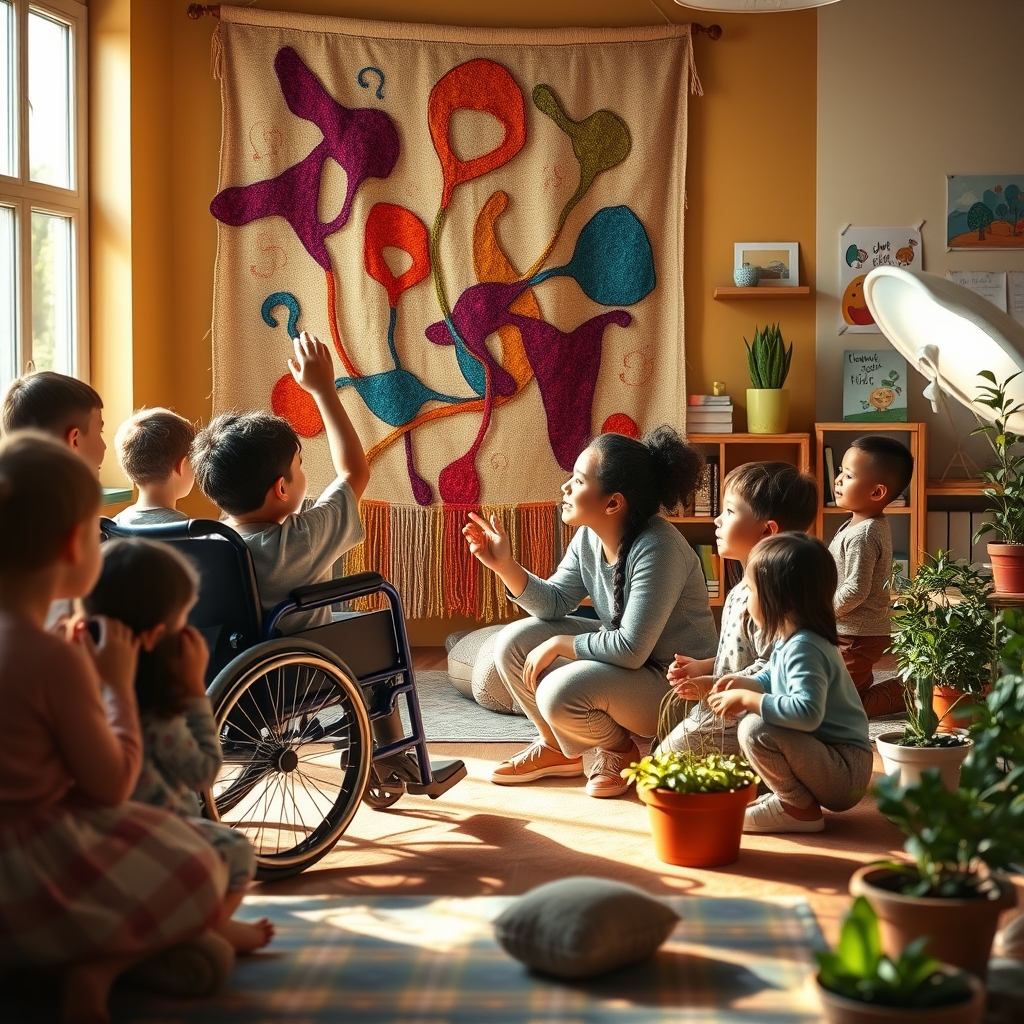
The classroom is not merely a space of desks and chalkboards, of lesson plans and standardized tests. It is a living, breathing entity, a tapestry woven from the threads of a thousand small gestures—each one a silent promise, a quiet acknowledgment, a fleeting touch that says, You belong here. These threads are not always visible, not always measurable, but they are the very fabric of inclusive education, the invisible hands that lift a child from the margins and place them at the center of their own story.
The Alchemy of Small Gestures
In the grand narrative of education, we often fixate on the monumental—the sweeping reforms, the groundbreaking methodologies, the bold declarations of equity. Yet, it is the unremarkable moments that often hold the most transformative power. A teacher’s hand resting briefly on a student’s shoulder as they pass by. A shared glance that lingers a second too long, heavy with unspoken understanding. The way a lesson plan bends, ever so slightly, to accommodate the child who learns differently. These are the gestures that do not make it into the official reports or the professional development seminars, but they are the ones that shape a child’s sense of self, of worth, of possibility.
Consider the child who struggles with anxiety, whose mind races like a river in flood, whose hands tremble at the thought of speaking aloud. For them, the classroom can feel like a storm they are constantly bracing against. But then, there is the teacher who notices the way their fingers twist in their lap, who offers a quiet nod instead of a demand for participation, who leaves a sticky note on their desk with a single word: Breathe. That note is not a cure, not a solution, but it is a thread—a single strand in the tapestry that tells that child, I see you. You are not alone.
The Geography of Belonging
Inclusive education is not a destination; it is a landscape, one that shifts and changes with every child who enters the room. Some will arrive with maps in hand, their paths well-trodden and familiar. Others will step into the terrain blindfolded, their routes obscured by the fog of learning disabilities, behavioral challenges, or the weight of societal expectations. The role of the educator is not to flatten the landscape, to make it uniform and predictable, but to help each child navigate it in their own way, to find the footholds that will carry them forward.
This is where the art of differentiated instruction reveals itself—not as a set of strategies to be mastered, but as a way of seeing, a lens that refracts the light of learning into a spectrum of possibilities. It is the recognition that the child who cannot sit still is not defiant, but perhaps kinesthetic, their body a conduit for understanding. It is the patience to wait for the child who speaks in fragments, whose thoughts arrive in bursts like fireworks, each one a revelation. It is the willingness to redesign the classroom not as a static space, but as a living organism, one that expands and contracts to hold the stories of every child who walks through its doors.
The Unseen Curriculum
Beneath the surface of lessons and assessments lies another curriculum, one that is taught not through textbooks, but through the quiet rhythms of the classroom. This is the curriculum of belonging—the way a teacher’s voice softens when a child is struggling, the way a peer offers a pencil without being asked, the way a moment of frustration is met not with punishment, but with curiosity. These are the lessons that shape a child’s heart as much as their mind, the ones that teach them whether they are valued, whether they are seen, whether they matter.
In the rush to meet standards and benchmarks, it is easy to overlook this unseen curriculum, to treat it as secondary to the real work of education. But what if it is the most important work of all? What if the true measure of a classroom’s success is not the test scores it produces, but the sense of safety it cultivates, the risks it encourages, the stories it makes space for? What if the most powerful tool in an educator’s arsenal is not a lesson plan, but a listening ear?
The Weight of a Name
Names are not just labels; they are the first gift we give a child, the first way we say, You are here. You exist. And yet, in the hustle of the classroom, names are often mispronounced, forgotten, or reduced to a roll call. For the child whose name is a melody unfamiliar to the teacher’s tongue, each mispronunciation is a small erasure, a reminder that they do not quite fit. For the child who is called by a nickname they did not choose, it is a denial of their autonomy, a refusal to see them as they are.
But when a teacher takes the time to learn the correct pronunciation, to practice it until it feels natural, it is an act of love. It is a thread in the tapestry, one that says, I see you. I honor you. You belong. The same is true for the child who is nonverbal, whose name is not spoken aloud but signed or spelled or communicated in a hundred other ways. To acknowledge that name, to hold space for it, is to affirm that child’s place in the world.
The Threads That Hold Us
Inclusive education is not a checklist; it is a practice, a daily recommitment to the idea that every child deserves to be seen, to be heard, to be held. It is the recognition that the threads of connection are not always neat or orderly, that they may tangle or fray, but that they are always worth weaving. It is the understanding that the tapestry is never finished, that each child who enters the classroom adds their own threads, their own colors, their own stories to the design.
And so, the work continues—not in grand gestures or sweeping declarations, but in the small, daily acts of attention, of patience, of love. It is in the way a teacher pauses to kneel beside a child’s desk, in the way a peer offers a hand to someone who has fallen, in the way a classroom is rearranged to make space for a wheelchair, a sensory tool, a quiet corner. These are the threads that hold us, the ones that remind us that education is not just about what we teach, but about who we are when we teach it. The tapestry is vast, and it is still being woven, one small gesture at a time.