The Unseen Threads: Weaving Humanity into the Fabric of Education
The classroom is not merely a space of desks and chalkboards, of lesson plans and standardized tests. It is a living, breathing entity, a tapestry woven from the quiet struggles and triumphant moments of those who inhabit it. To teach is not just to impart knowledge; it is to hold space for the raw, unfiltered humanity of each student who walks through the door. And yet, in the relentless march toward efficiency and measurable outcomes, we often forget that education is not a transaction—it is a relationship, one that demands patience, empathy, and an unwavering commitment to the unseen threads that bind us all.
The Myth of the Monolith
We speak of “the classroom” as if it were a singular, uniform experience, a one-size-fits-all sanctuary where every child learns in the same way, at the same pace, under the same conditions. But this is a fiction, a convenient illusion that allows us to tidy away the messy, beautiful diversity of human minds. The truth is that no two students arrive at the same starting line. Some carry invisible weights—anxiety that hums like static in their veins, trauma that lingers like a shadow, or learning differences that make the path to understanding feel like navigating a labyrinth blindfolded. Others may appear unburdened, but even they are shaped by forces beyond the classroom walls: the expectations of parents, the pressures of peers, the relentless drumbeat of a world that demands they fit into neat, predefined boxes.
Inclusive education is not about erasing these differences; it is about honoring them. It is about recognizing that the child who struggles to read aloud may be the one who sees the world in colors the rest of us cannot perceive. The student who disrupts the lesson with restless energy might be the one who, given the right outlet, could design the next great innovation. The quiet observer in the corner, often overlooked, may be the one who notices the details that change everything. To teach inclusively is to refuse the myth of the monolith—to see each student as a universe unto themselves, deserving of the space to unfold in their own time, in their own way.
The Alchemy of Adaptation
If education is a relationship, then differentiated instruction is the art of listening deeply enough to respond. It is not a checklist of strategies or a set of rigid protocols but a fluid, intuitive dance between teacher and student. The best educators are alchemists, transforming the base metals of curriculum and pedagogy into gold through the simple act of paying attention. They notice when a student’s frustration is not defiance but a cry for help. They recognize that the child who shuts down during group work might thrive in a one-on-one setting. They understand that the same lesson delivered in three different ways can unlock three different minds.
But adaptation is not just about technique; it is about mindset. It requires a willingness to surrender the illusion of control, to embrace the uncertainty of not knowing what will work until you try. It demands humility—the humility to admit that the lesson plan you spent hours crafting might need to be scrapped entirely because, on this particular day, with this particular child, something else is needed. This is the heart of individualized education: the understanding that learning is not a linear path but a winding road, full of detours and unexpected vistas. The role of the teacher is not to dictate the journey but to walk alongside the student, offering a hand when the terrain gets rough.
The Weight of the Invisible
There is a quiet violence in the way we often approach mental health and social-emotional learning in schools. We treat them as add-ons, as optional extras to be squeezed into an already overcrowded schedule, rather than as the foundation upon which all other learning rests. We talk about “student wellbeing” in the same breath as we discuss test scores and graduation rates, as if the two could ever be separated. But the truth is that a child who is drowning in anxiety cannot learn algebra. A student who feels unseen cannot absorb the nuances of Shakespeare. The mind and the heart are not separate entities; they are intertwined, each shaping the other in ways we are only beginning to understand.
Neurodiversity awareness is not a trend or a buzzword; it is a moral imperative. It is the recognition that the spectrum of human cognition is vast and varied, and that what we call “disabilities” are often simply differences in how the brain processes the world. The child with ADHD is not “disruptive”; they are wired for movement, for exploration, for a kind of thinking that thrives in environments where stillness is not the default. The student with autism is not “withdrawn”; they are navigating a world that was not designed for their way of experiencing it. To create truly inclusive classrooms, we must first dismantle the ableist assumptions that underpin so much of our educational system. We must ask ourselves: Who are we designing these spaces for? And who are we leaving behind?
The Classroom as a Living Organism
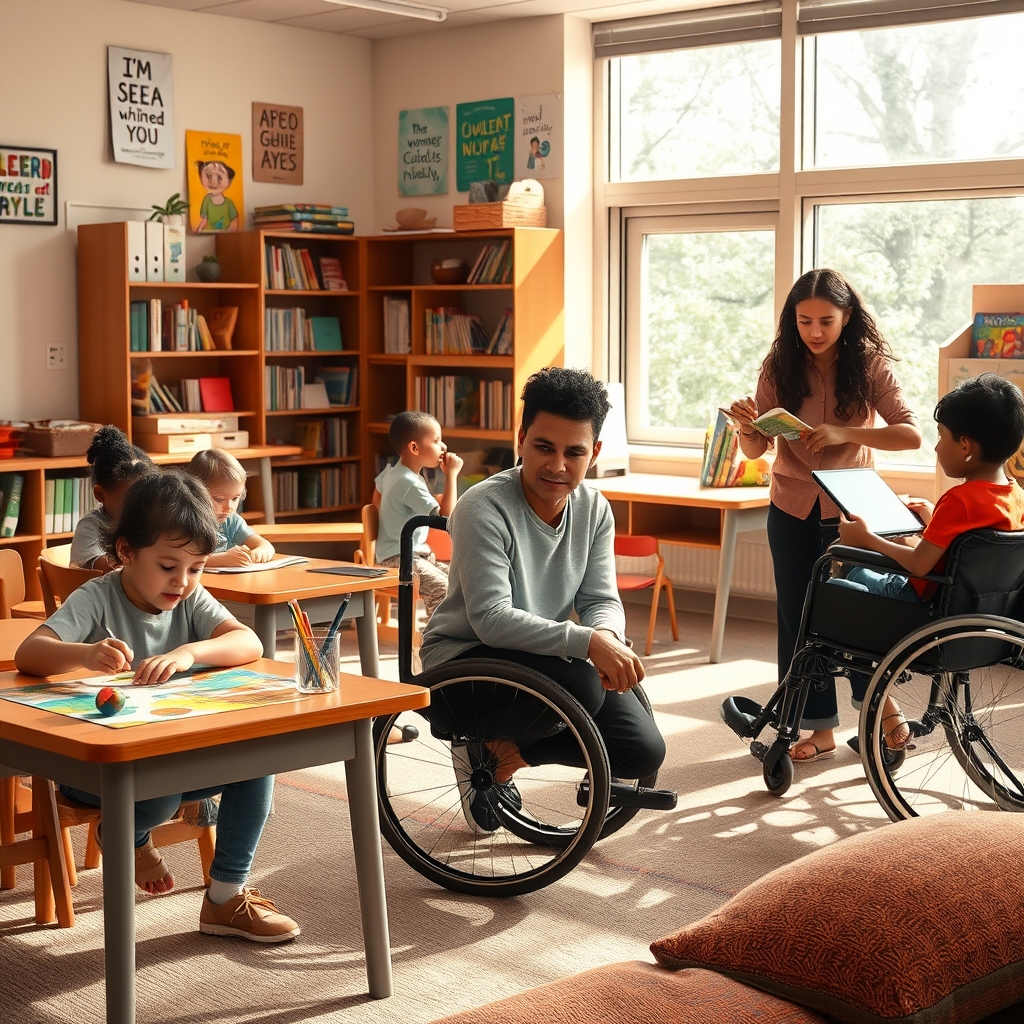
An inclusive classroom is not a static place; it is a living organism, constantly evolving in response to the needs of those within it. It is a space where mistakes are not failures but opportunities for growth, where vulnerability is not weakness but strength. It is a place where the teacher is not the sole authority but a co-learner, where students are not passive recipients of knowledge but active participants in their own education. This kind of classroom does not happen by accident. It is the result of intentional design—of furniture arranged to encourage collaboration, of walls adorned with the work of every student, of routines that prioritize connection over compliance.
But perhaps the most radical act of inclusion is simply this: to see each student as a whole person, not just a set of data points or a collection of behaviors to be managed. It is to look beyond the surface—to the child who is grieving a loss they haven’t spoken of, to the student who is carrying the weight of a family’s expectations, to the quiet dreamer who is afraid to share their ideas for fear of being laughed at. It is to recognize that education is not just about preparing students for the future but about helping them navigate the present, with all its complexities and contradictions.
The tapestry of education is not woven in a day, nor is it the work of a single hand. It is a collaborative effort, a slow and patient stitching together of countless moments—of a teacher staying late to help a struggling student, of a classmate offering a word of encouragement, of a school community coming together to lift up those who are falling behind. It is messy and imperfect, full of loose threads and uneven edges. But it is also beautiful, precisely because of its imperfections. For it is in those imperfections that the humanity of education reveals itself—not as a system to be optimized, but as a living, breathing testament to the resilience and potential of every child who walks through its doors. And perhaps that is the most important lesson of all: that the true measure of education is not what we teach, but how we make each other feel along the way.