
The Emotional Olympics: When Education Became a Feelings Factory
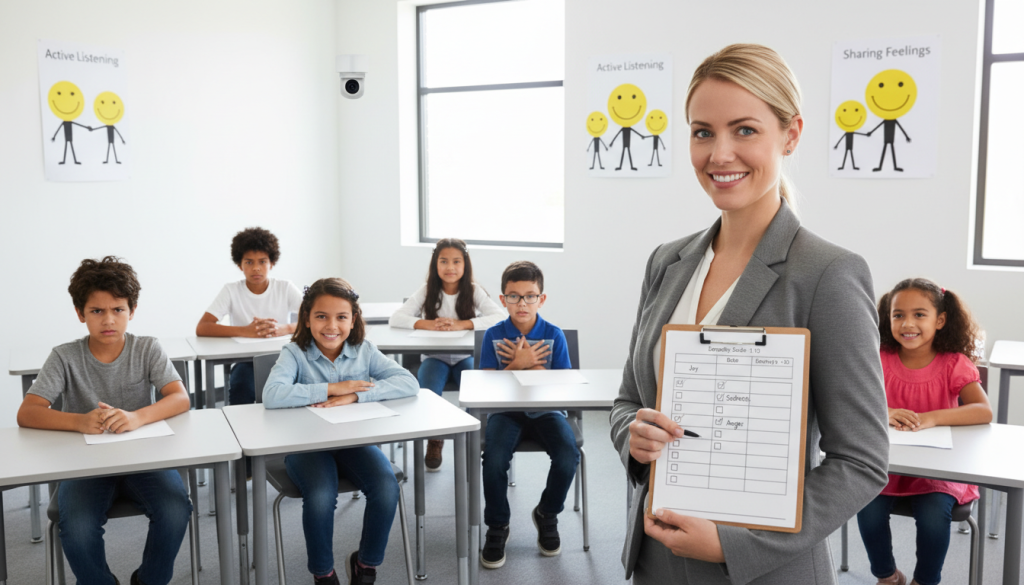
Ah, the modern educational landscape! A glorious tapestry woven with buzzwords, initiatives, and the perennial quest for the next grand solution to all of society’s woes. And currently, shimmering brightest among these pedagogical panaceas, is the magnificent beast known as Social Emotional Learning (SEL). Once upon a time, schools were content to merely impart knowledge, perhaps a smattering of arithmetic, a dash of history, and the occasional literary masterpiece. But no, that was far too simplistic, far too un-holistic. We now understand that the true measure of a student isn’t their grasp of calculus, but their ability to articulate their ‘inner zen’ after a particularly challenging pop quiz.
The Grand Performance of “Wellbeing”
It seems we’ve collectively decided that the primary function of a school is no longer just intellectual development, but rather the meticulous cultivation of emotional literacy. Students aren’t just learning; they’re *feeling*. And not just feeling, but *identifying* those feelings, *managing* those feelings, and then, crucially, *sharing* those feelings in a ‘safe and brave space.’ It’s a truly heartwarming transformation, turning every classroom into a miniature therapy session, albeit one where the therapist also has to grade your essay on the causes of the French Revolution.
The Feelings Factory Opens its Doors
The shift is palpable. Our children, bless their little cotton socks, are now enrolled in the emotional industrial complex. We’re not just teaching them to read; we’re teaching them to read the room. We’re not just teaching them to write; we’re teaching them to write ‘I feel…’ statements. It’s a beautiful, if somewhat exhausting, vision. Imagine the sheer efficiency! We’re no longer just educating minds; we’re manufacturing well-adjusted, emotionally articulate citizens, ready to navigate the complexities of life with a perfectly calibrated emotional toolkit. Never mind if they can’t balance a checkbook; at least they can identify their triggers!
On the Assembly Line of Empathy
And what an assembly line it is! From morning meetings dedicated to ‘checking in’ with one’s emotional state, to elaborate curriculum modules on ‘responsible decision-making,’ no stone is left unturned in the grand project of emotional engineering. We’re meticulously crafting individuals who can not only solve quadratic equations but also demonstrate ’empathy’ on demand, often for a rubric. It’s truly a marvel of modern educational design, turning the messy, unpredictable business of human emotion into a standardized, teachable, and – most importantly – assessable skill.
Teachers: Now Accepting Emotional Resumes
Of course, all this emotional heavy lifting falls squarely on the shoulders of our beloved educators. Once upon a time, a teacher needed to be an expert in their subject matter, perhaps a dab hand at classroom management, and possess a modicum of patience. Now? They’re frontline mental health workers, social workers, life coaches, and emotional first responders, all wrapped into one underpaid, overworked package. It’s a testament to their boundless dedication, or perhaps their sheer bewilderment, that they continue to show up.
The Unpaid Therapist’s Couch
Every ‘challenging behavior’ is now an opportunity for a ‘teachable moment’ in emotional regulation. Every playground scuffle becomes a case study in conflict resolution. And every quiet, withdrawn child is a potential project for ‘re-engagement’ through targeted social-emotional interventions. Teachers are now expected to possess the diagnostic skills of a seasoned psychologist, the counseling prowess of a therapist, and the endless wellspring of compassion typically reserved for saints. All, of course, while still ensuring students meet their standardized test targets. It’s a truly holistic approach: exhaust the teacher, uplift the student.
Quantifying the Unquantifiable: The SEL Report Card
And what would any educational initiative be without its metrics? Because you can’t truly ‘know’ if a child is emotionally intelligent unless you can assign them a score, right? Hence, the rise of the SEL report card, the ‘social emotional growth rubric,’ and the endless surveys designed to measure everything from ‘self-awareness’ to ‘relationship skills.’ It’s a brave new world where ‘plays well with others’ is no longer a simple observation but a data point, meticulously collected and analyzed to ensure optimal emotional development.
The Illusion of Emotional Metrics
We’re now in the business of quantifying the soul, of charting the delicate dance of human emotion on a spreadsheet. Is a child ‘consistently’ demonstrating empathy? Is their ‘self-management’ typically effective? These are the profound questions that keep educators up at night, not whether little Timmy understands fractions. It’s a beautiful illusion, this idea that we can reduce the vast, complex inner world of a child to a series of checkboxes and numerical ratings, all in the name of ‘accountability’ and ‘progress monitoring.’ Because if you can’t measure it, it simply doesn’t exist, especially not in a school district.
The Industry of Inner Peace: Cashing in on Conscientiousness
Naturally, where there’s a new educational imperative, there’s an entire industry ready to swoop in and provide the ‘solutions.’ SEL has spawned a veritable gold rush of consultants, curriculum providers, assessment tools, and professional development programs. Suddenly, every educational publisher has a ‘mindfulness module,’ every ed-tech startup boasts an ’emotional intelligence platform,’ and every conference features a keynote speaker on ‘cultivating resilience.’ It’s a booming market, fueled by the very best intentions and the ever-present anxiety that if we don’t buy this program, our students will simply devolve into emotionally stunted automatons.
Consultants, Curricula, and the Commodification of Compassion
The irony, of course, is that while we’re busily purchasing packaged empathy and standardized self-awareness, the fundamental issues that often truly impact student wellbeing – poverty, systemic inequities, underfunded schools, and overworked parents – remain largely unaddressed by these shiny new programs. But why tackle those messy, intractable problems when you can simply implement a new SEL curriculum and feel like you’re making a profound difference? It’s a much cleaner, much more marketable solution, promising inner peace and emotional regulation through a series of carefully designed worksheets and breathing exercises.
So, as we continue our fervent embrace of the Emotional Olympics, it’s worth pausing to ponder whether we’re truly fostering genuine emotional intelligence and resilience, or simply training students to perform acceptable emotional displays for an increasingly complex and demanding educational system. Are we nurturing their inner lives, or are we just adding another layer of performance anxiety to their already overflowing plates? Perhaps the greatest lesson in social-emotional learning might be recognizing when to step back, allow children to simply be, and trust that some aspects of human development, particularly those of the heart and soul, might just be better left to unfold organically, rather than being meticulously managed, measured, and monetized within the confines of a classroom.