Navigating the New Frontier: Key Trends Shaping Modern Education
The landscape of education is undergoing a profound transformation, moving beyond traditional models to embrace dynamic, learner-centric approaches. At the heart of this shift is the growing emphasis on Personalized Learning, tailoring educational experiences to individual student needs and paces. This evolution is not just about technology; it’s about fundamentally rethinking how knowledge is acquired, skills are developed, and potential is unlocked. We are witnessing an exciting era where innovative strategies are converging to create more engaging, effective, and equitable learning environments for everyone.
Harnessing Intelligence for Tailored Education
Artificial Intelligence in Education (AIEd) is revolutionizing how we approach instruction, moving beyond one-size-fits-all teaching. AI-powered Adaptive Learning Platforms analyze student performance and progress in real-time, then dynamically adjust the curriculum to match their specific learning style, pace, and knowledge gaps. This ensures that every learner receives content that is optimally challenging yet supportive, preventing both boredom and frustration while maximizing comprehension.
These sophisticated systems can pinpoint areas where a student struggles and recommend targeted resources, whether it’s supplementary readings, interactive exercises, or specific video tutorials. This makes the learning process incredibly efficient and personalized. Furthermore, AI can automate administrative tasks like grading and progress tracking, freeing educators to focus more on direct student interaction, mentorship, and fostering deeper critical thinking. The integration of AI is making truly individualized learning a scalable and practical reality for institutions worldwide.
Engaging Minds Through Innovative Pedagogies
To capture and sustain Student Engagement, educators are increasingly turning to creative and interactive pedagogical methods. Gamification, for instance, integrates game-like elements such as points, badges, leaderboards, and quests into lessons, transforming routine tasks into exciting challenges. This approach not only fosters intrinsic motivation but also encourages active participation, problem-solving, and perseverance in a fun, low-stakes environment.
Project Based Learning (PBL) offers another powerful avenue for deep engagement, allowing students to tackle real-world problems through collaborative, hands-on projects. This method cultivates critical thinking, complex problem-solving skills, and a deeper understanding of interdisciplinary subjects, preparing students for practical application. Coupled with Microlearning, which delivers content in short, digestible modules focused on specific learning objectives, these strategies make learning more accessible, less intimidating, and perfectly suited for busy modern learners.
Blending Realities: Hybrid and Virtual Learning Environments
The lines between physical and digital classrooms are blurring, giving rise to flexible and resilient educational models. Hybrid Learning and Blended Learning thoughtfully combine face-to-face instruction with online components, offering students the best of both worlds. This flexibility allows learners to access resources and complete assignments at their convenience, while still benefiting from direct interaction with peers and instructors for deeper discussion and collaborative activities.
Virtual Classrooms provide immersive online spaces for synchronous and asynchronous collaborative learning experiences, effectively transcending geographical barriers and expanding access to education. Alongside this, Mobile Learning empowers students to learn anytime, anywhere, using their smartphones and tablets, integrating education seamlessly into their daily lives. The widespread availability and increasing quality of Open Educational Resources (OER) further democratize access to high-quality learning materials, making education more inclusive and affordable for a global audience.
Cultivating Holistic Development and Future-Ready Skills
Education today extends far beyond the acquisition of academic knowledge to encompass the holistic development of the learner. Social Emotional Learning (SEL) programs are crucial for developing self-awareness, self-management, social awareness, relationship skills, and responsible decision-making – essential competencies for navigating life’s complexities and fostering well-being. Insights from Neuroeducation are also profoundly informing teaching practices, optimizing learning strategies by understanding how the brain processes information, remembers, and learns most effectively, leading to more brain-friendly pedagogies.
Preparing students for the future workforce demands a strong focus on Career Readiness and Competency Based Education. This innovative approach emphasizes mastering specific, demonstrable skills and competencies rather than simply accumulating credit hours or completing courses. The rapid rise of Microcredentials provides verifiable digital proof of these specialized skills, allowing individuals to showcase their expertise and effectively bridging the gap between educational attainment and the specific demands of Skills Based Hiring practices in various industries, from tech to healthcare.
Empowering Learners with Advanced Technology and Collaboration
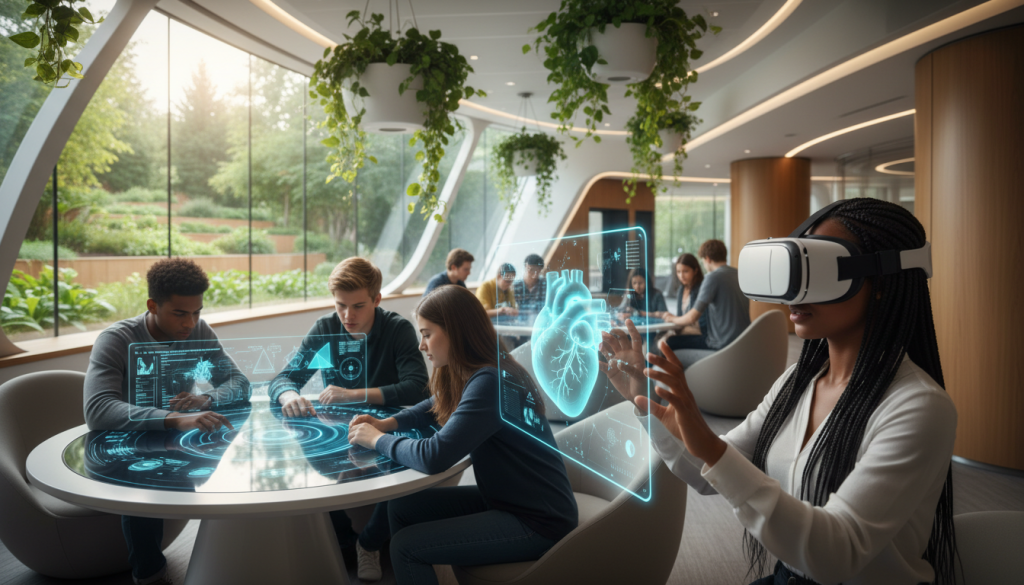
Immersive Technology, such as Virtual Reality (VR) and Augmented Reality (AR), is transforming how students interact with complex concepts and environments. Imagine exploring ancient civilizations in a fully interactive 3D reconstruction, conducting virtual science experiments without expensive lab equipment, or dissecting a virtual human heart with unparalleled detail. These tools create unforgettable, experiential learning opportunities that deepen understanding, enhance retention, and spark curiosity in subjects that might otherwise seem abstract.
Developing strong Digital Literacy is paramount in our increasingly interconnected world, equipping students with the critical skills to navigate, evaluate, create, and communicate digital content responsibly and effectively. Collaborative Learning and Peer To Peer Tutoring further enhance these essential 21st-century skills, fostering teamwork, communication, and shared knowledge creation among students. Additionally, engaging STEM Activities ignite passion for science, technology, engineering, and mathematics, while informative Educational Podcasts offer diverse, accessible avenues for exploring new subjects and expanding horizons, promoting a culture of continuous Lifelong Learning in an accessible format for everyone.
The future of education is undeniably bright, characterized by an unprecedented focus on the individual learner, empowered by cutting-edge technology and informed by a deeper understanding of human development. By strategically embracing Adaptive Learning Platforms, fostering unparalleled Student Engagement through innovative methods like Gamification and Project Based Learning, and integrating holistic approaches such as Social Emotional Learning, we can collectively design and cultivate educational ecosystems that truly prepare individuals not just for academic success, but for a dynamic, ever-evolving world. The continuous evolution of learning strategies, from bite-sized Microcredentials validating specific skills to deeply immersive experiences powered by Immersive Technology, ensures that education remains relevant, accessible, and profoundly impactful, equipping every learner with the essential tools and mindset to thrive throughout their entire lives.