Cultivating Belonging: Building Truly Inclusive Classrooms for Every Learner
The landscape of education is continuously evolving, shifting from a one-size-fits-all model to a more nuanced, student-centered approach. At the heart of this transformation lies the profound understanding that every child brings a unique set of strengths, challenges, and perspectives to the learning environment. Creating truly inclusive classrooms is no longer just an aspiration but a pedagogical imperative, requiring a thoughtful integration of strategies that honor diversity and foster a sense of belonging for all learners.
The Foundation: Universal Design for Learning (UDL)
A cornerstone of inclusive education is Universal Design for Learning (UDL). Far from being a reactive measure for students with identified needs, UDL is a proactive framework designed to remove barriers to learning from the outset. It operates on three core principles: providing multiple means of representation (how information is presented), multiple means of action and expression (how students demonstrate what they know), and multiple means of engagement (how students are motivated and sustained in learning). By embedding flexibility and choice into curriculum design, UDL ensures that learning pathways are accessible and meaningful for the widest possible range of learners, anticipating diverse needs rather than retrofitting accommodations.
Embracing Every Mind: Neurodiversity Affirming Practice
Complementing UDL is the increasingly vital shift towards Neurodiversity Affirming Practice. This approach views neurological differences—such as autism, ADHD, dyslexia, and Tourette’s syndrome—not as deficits to be cured, but as natural variations in human cognition. It challenges the medical model that often pathologizes these differences, instead advocating for an environment that celebrates diverse ways of thinking, processing information, and interacting with the world. In a neurodiversity affirming classroom, the focus shifts from ‘fixing’ the student to understanding and adapting the environment and instructional methods to support their unique strengths and learning styles, fostering self-advocacy and a positive self-identity.
Strategies for Diverse Learners: Differentiated Instruction and Assistive Technology
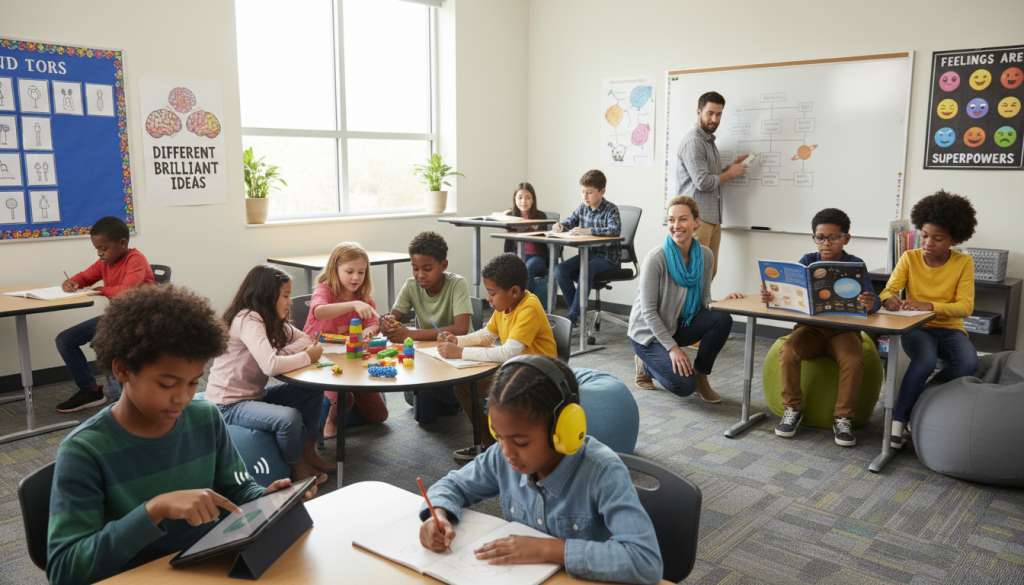
Translating UDL and neurodiversity-affirming principles into daily practice often involves Differentiated Instruction. This strategy allows educators to tailor content, process, and product to meet individual student needs within the same classroom. Whether it’s offering different reading levels for a text, providing various options for project completion, or varying the amount of support provided during a task, differentiation ensures that every student is appropriately challenged and supported. Hand-in-hand with differentiation, Assistive Technology (AT) plays a crucial role. From text-to-speech software and graphic organizers to noise-canceling headphones and specialized keyboards, AT levels the playing field, empowering students to access information, express their understanding, and participate fully in learning activities that might otherwise be inaccessible. It’s about providing the right tools to unlock potential.
Beyond Academics: Nurturing the Whole Child with Social Emotional Learning
An inclusive classroom recognizes that academic success is deeply intertwined with social and emotional well-being. Social Emotional Learning (SEL) is therefore an indispensable component, focusing on the development of five core competencies: self-awareness, self-management, social awareness, relationship skills, and responsible decision-making. Explicitly teaching and integrating SEL into the curriculum helps students navigate complex emotions, build healthy relationships, resolve conflicts constructively, and develop empathy. These skills are not just ‘soft skills’; they are foundational for academic engagement, personal resilience, and success in life beyond the classroom.
Building Bridges: Collaborative Teaching and Executive Functioning Coaching
Effective inclusion often thrives on collaboration. Collaborative Teaching models, such as co-teaching, bring together general education and special education teachers to share instructional responsibilities, leveraging diverse expertise to benefit all students. This partnership ensures that a wider range of teaching strategies, accommodations, and supports are seamlessly integrated into the learning environment, reducing stigma and enhancing the learning experience for every child. Furthermore, for many neurodivergent students and those with executive functioning challenges, targeted Executive Functioning Coaching can be transformative. This involves explicit instruction and practice in skills like planning, organization, time management, task initiation, and self-regulation, providing students with the metacognitive tools they need to become more independent and effective learners.
The Inclusive Classroom: A Shared Vision
When Universal Design for Learning, Neurodiversity Affirming Practice, Differentiated Instruction, Assistive Technology, Social Emotional Learning, Collaborative Teaching, and Executive Functioning Coaching are woven together, they create a rich tapestry of support and opportunity. The inclusive classroom, built on these principles, is not merely a place where students with diverse needs are accommodated; it is a vibrant ecosystem where every learner is valued, understood, and empowered to thrive. It fosters a culture of empathy, respect, and mutual understanding, preparing all students not just for academic achievement, but for a world that increasingly demands adaptability, compassion, and the ability to collaborate across differences.
Ultimately, the commitment to inclusive education transcends pedagogical techniques; it reflects a profound belief in the inherent worth and potential of every individual. By intentionally designing learning environments that celebrate neurodiversity, provide flexible pathways, and nurture social-emotional growth, educators are not just teaching subjects; they are cultivating a generation of critical thinkers, compassionate citizens, and confident individuals ready to contribute their unique gifts to the world. This holistic approach ensures that the educational journey is not just about acquiring knowledge, but about discovering one’s place in a community that truly sees and values them.