The Invisible Ink of Belonging: How the Unwritten Lessons Shape the Heart of Education
The classroom is a living palimpsest, where the most profound lessons are not those etched in chalk or printed in textbooks, but the ones written in invisible ink—lessons of belonging, of quiet recognition, of the unspoken understanding that every child carries a universe within them. These are the lessons that linger long after the bell rings, the ones that shape not just what a child knows, but who they become. And yet, they are the hardest to teach, for they cannot be measured in standardized tests or quantified in data reports. They exist in the spaces between words, in the pauses between breaths, in the way a teacher’s gaze lingers just a second longer on the child who thinks no one sees them.
The Alchemy of Being Seen
There is a kind of magic in the moment when a child realizes they are seen—not just for their abilities or disabilities, their compliance or defiance, but for the entirety of who they are. It is a magic that defies the rigid structures of educational frameworks, slipping through the cracks of Individualized Education Plans and behavioral interventions like water through fingers. This is the alchemy of belonging: the transformation of a room full of individuals into a community where each person’s presence is not just tolerated but celebrated. It is not something that can be mandated or scripted; it is something that must be felt, cultivated, and nurtured in the quiet corners of the classroom.
Consider the child who sits at the edge of the group, their body angled slightly away, their eyes darting between the floor and the door, as if calculating the distance to escape. They are not disruptive, not defiant, not even particularly noticeable—until you look closer. And then you see it: the way their fingers twist around the hem of their shirt, the way their breath hitches when called upon, the way their shoulders tense as if bracing for impact. This child is not a problem to be solved; they are a story waiting to be heard. The question is not how to fix them, but how to create a space where their story can unfold without fear.
The Geography of Trust
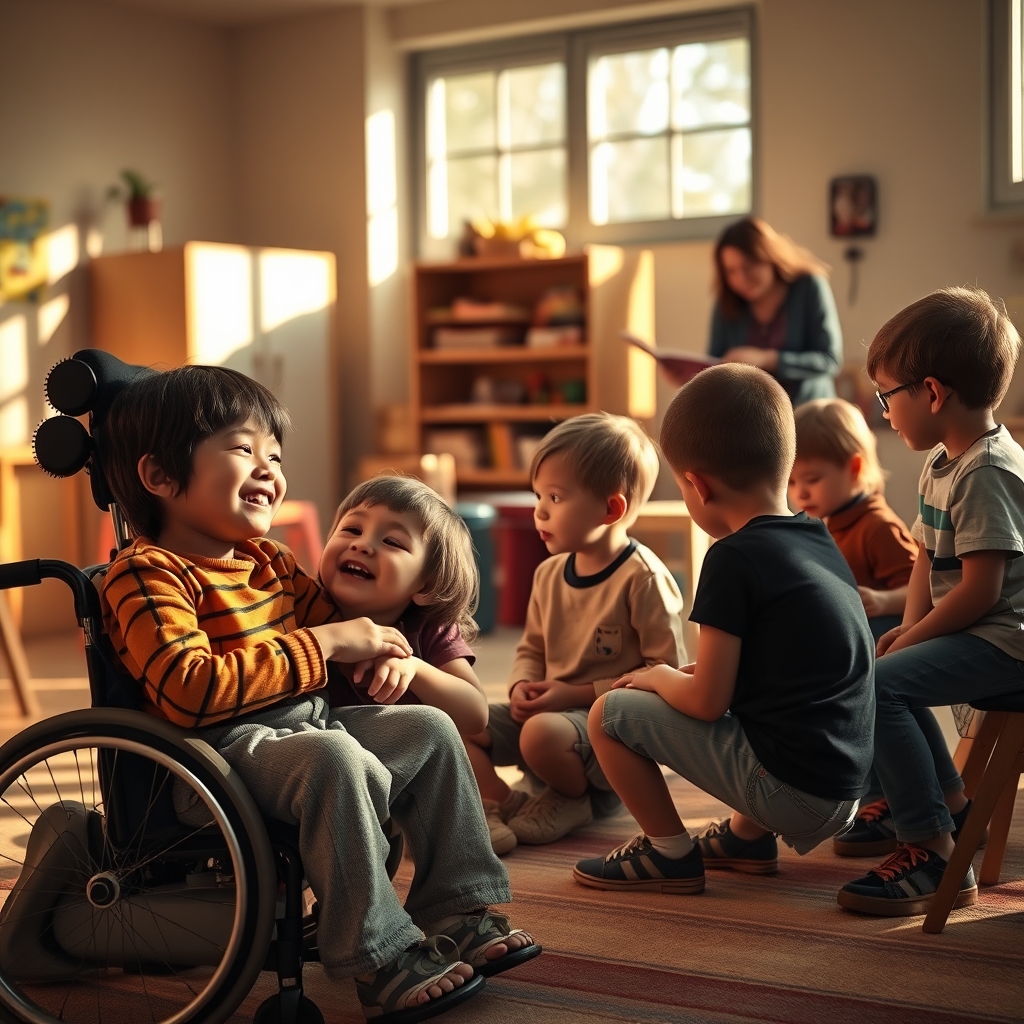
Trust is the invisible architecture of an inclusive classroom. It is the foundation upon which every other strategy, intervention, and lesson plan is built. Without it, even the most well-intentioned efforts—differentiated instruction, social-emotional learning, adaptive methods—become hollow, performative gestures. Trust is not built through grand declarations or sweeping reforms; it is built in the small, almost imperceptible moments: the way a teacher remembers the name of a student’s pet, the way they kneel to eye level when speaking to a child in a wheelchair, the way they pause before correcting a mistake to ask, “What were you trying to say?” rather than “That’s wrong.”
These moments are the threads that weave the fabric of belonging. They are the quiet affirmations that say, You are here, and you matter. They are the antidote to the isolation that so many children—especially those with learning disabilities, neurodivergent traits, or emotional struggles—feel in spaces that were not designed with them in mind. And yet, trust is fragile. It can be shattered by a single dismissive comment, a single moment of impatience, a single instance where a child feels their presence is an inconvenience rather than a gift.
The Unseen Curriculum of the Soul
Education is often spoken of in terms of outcomes: test scores, graduation rates, college acceptances. But what of the outcomes that cannot be measured? What of the child who learns to trust themselves because someone else trusted them first? What of the student who discovers their voice because someone else believed it was worth hearing? These are the lessons of the unseen curriculum, the ones that shape not just the mind but the soul. They are the lessons of character education values and moral education, though they are rarely labeled as such. They are the lessons that teach empathy not through lectures but through lived experience, that teach resilience not through platitudes but through the quiet endurance of being seen and loved despite one’s flaws.
This is the heart of holistic education: the understanding that a child is not a vessel to be filled but a flame to be kindled. It is the recognition that academic growth is only one dimension of learning, and that the others—emotional, social, spiritual—are equally vital. It is the commitment to seeing the whole child, not just the parts that fit neatly into the boxes of educational psychology or behavioral intervention. And it is the courage to admit that sometimes, the most important thing a teacher can do is not to instruct, but to listen.
The Weight of Small Gestures
In a world that often equates value with productivity, it is easy to overlook the power of small gestures. A smile, a nod, a moment of undivided attention—these are the currency of human connection, the building blocks of belonging. They are the things that cost nothing and yet mean everything. They are the reason a child might walk into a classroom feeling invisible and walk out feeling like they are the only one in the room. And they are the reason that, years later, that same child might look back and realize that the most important lesson they ever learned was not about algebra or history, but about the fact that they were never alone.
These gestures are not grand or dramatic. They do not make headlines or win awards. They are the quiet, consistent acts of love that say, I see you. I am here. You belong. They are the reason that inclusive education is not just a set of strategies or a collection of best practices, but a way of being in the world. They are the reason that the most transformative classrooms are not the ones with the most resources or the most innovative programs, but the ones where every child feels, in their bones, that they are home.
And so, as we navigate the complexities of modern education—with its buzzwords and its bureaucracies, its data-driven decisions and its performative inclusivity—let us not forget the invisible ink. Let us remember that the most powerful lessons are not the ones we teach, but the ones we embody. Let us remember that belonging is not something we can give to a child, but something we must create together, one small gesture at a time. For in the end, it is not the tests we pass or the grades we earn that define us, but the connections we forge and the love we leave behind. And perhaps, if we are lucky, we will look back one day and realize that the classroom was never just a place of learning, but a sanctuary of the soul.