The Quiet Revolution: How the Soft Edges of Education Shape the Hard Truths of Learning
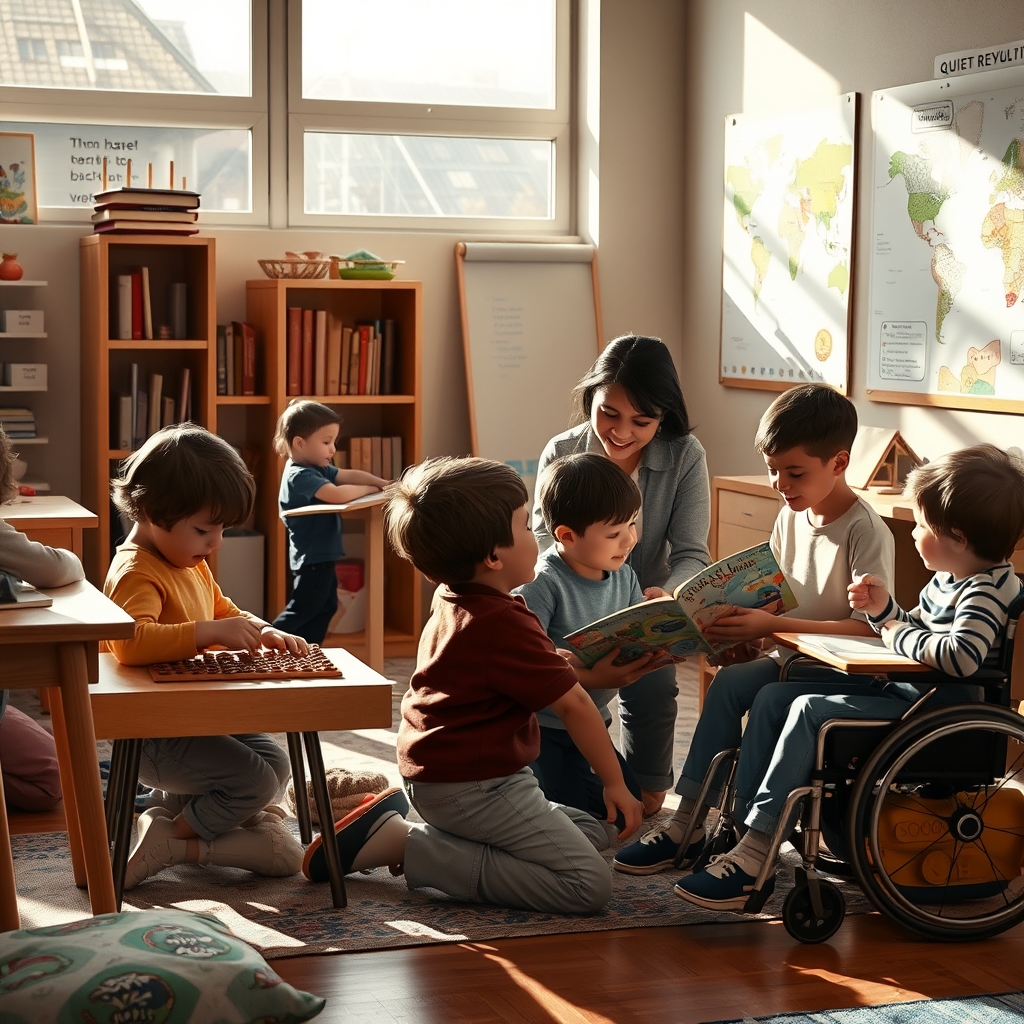
The classroom has always been a theater of contradictions—a place where the rigid lines of curriculum meet the fluid, unpredictable currents of human growth. We speak of inclusion as if it were a destination, a fixed point on a map where every child arrives, suitcase in hand, ready to be slotted into the grand design of learning. But what if inclusion is not a place at all? What if it is, instead, a way of seeing, a quiet revolution that begins not with policies or programs, but with the willingness to sit with the discomfort of not knowing?
The Myth of the Perfect Fit
We have built an education system that prizes uniformity, where success is measured in neat rows of desks and standardized test scores. Yet, the most profound moments of learning often happen in the cracks—when a child who struggles to read finds solace in a story told through pictures, or when a student with ADHD discovers that their boundless energy is not a flaw but a different kind of focus. These are not exceptions to the rule; they are the rule rewritten. The myth of the perfect fit is the belief that every child must conform to a single mold, and it is a myth that crumbles under the weight of its own rigidity.
Differentiated instruction, individualized education plans, adaptive learning methods—these are not just strategies but acknowledgments of a fundamental truth: learning is not a one-size-fits-all endeavor. It is a deeply personal, often messy process that defies the neat categories we try to impose upon it. The challenge, then, is not to force every child into the same shape, but to create spaces where their unique contours can be seen, honored, and nurtured.
The Invisible Threads of Connection
There is a moment in every teacher’s journey when they realize that the most important lessons they teach are not the ones written in the curriculum. It is the lesson of belonging—the quiet assurance that a child’s presence matters, that their voice is heard, that their struggles are not burdens but part of the shared human experience. This is the heart of social-emotional learning, the unspoken curriculum that shapes not just what students know, but who they become.
Yet, in our rush to quantify and measure, we often overlook these invisible threads of connection. We reduce mental health education to a checklist of coping strategies, character education to a series of moral platitudes, and behavioral interventions to a set of rewards and punishments. But true learning—learning that sticks to the ribs, that shapes the soul—cannot be reduced to a formula. It is born in the spaces between teacher and student, in the moments of shared laughter, of quiet understanding, of frustration and triumph. It is the alchemy of human connection, and it cannot be standardized.
The Weight of Expectations
We ask teachers to be many things: instructors, counselors, mediators, advocates. We ask them to navigate the complexities of neurodiversity, to design classrooms that are both inclusive and challenging, to balance the needs of the individual with the demands of the collective. And we do this in a system that often treats them as replaceable cogs in a machine, where professional development is less about growth and more about compliance, where the pressure to perform can drown out the quiet voice of intuition.
But what if the most radical act a teacher can commit is not to follow the script, but to rewrite it? What if the key to equity in education lies not in more policies, but in the courage to question them? The weight of expectations can be crushing, but it is also the crucible in which real change is forged. It is in the moments when teachers dare to deviate from the plan, to trust their instincts, to see the child before the diagnosis, that the true work of education happens.
The Unfinished Symphony of Learning
Early childhood education teaches us that learning is not a linear progression but a spiral, a dance of steps forward and back, of leaps and stumbles. The same is true of inclusive education. It is not a static state but a dynamic process, a constant negotiation between what is and what could be. The goal is not to create a perfect system, but to cultivate a mindset—one that sees diversity not as a problem to be solved, but as a strength to be celebrated.
This mindset requires humility, the recognition that we do not have all the answers. It requires patience, the willingness to sit with uncertainty, to listen more than we speak, to learn as much as we teach. It requires a shift from seeing education as a product to be delivered to seeing it as a relationship to be nurtured. And it requires us to remember that the most important lessons are not the ones we plan, but the ones that emerge when we create the space for them to unfold.
The classroom is not a factory. It is a garden, where every plant grows at its own pace, where the soil must be tended with care, where the harvest is not just the fruit but the act of growing itself. The quiet revolution of education is not about tearing down the old structures, but about softening their edges, about making room for the wild, unpredictable beauty of human potential. It is about recognizing that the most powerful tool in a teacher’s arsenal is not a lesson plan, but a heart open to the possibility that every child, in their own way, has something to teach us.