
The Great Inclusion Illusion: When Equity Becomes Just Another Buzzword in the Education Circus
Ah, inclusive education—the noble pursuit of ensuring every child, regardless of ability, background, or neurotype, gets a fair shot at learning. Or at least, that’s the theory. In practice, it often feels like watching a magician pull a rabbit out of a hat, only to realize the rabbit was there all along, and the real trick was convincing the audience it was magic. Welcome to the grand illusion of modern pedagogy, where equity is the buzzword du jour, and everyone’s scrambling to prove they’re on board—even if they’re not entirely sure what the boat looks like.
The Inclusion Paradox: Where Everyone Belongs (But No One Really Does)
Inclusive education promises a classroom where diversity isn’t just tolerated but celebrated. Sounds lovely, right? Except, like most things in education, the execution is about as smooth as a kindergartener’s first attempt at finger painting. Schools plaster their websites with stock photos of smiling, diverse children holding hands under rainbows, while in reality, the “inclusive” classroom often resembles a game of educational Jenga—one wrong move, and the whole structure threatens to collapse under the weight of good intentions and insufficient resources.
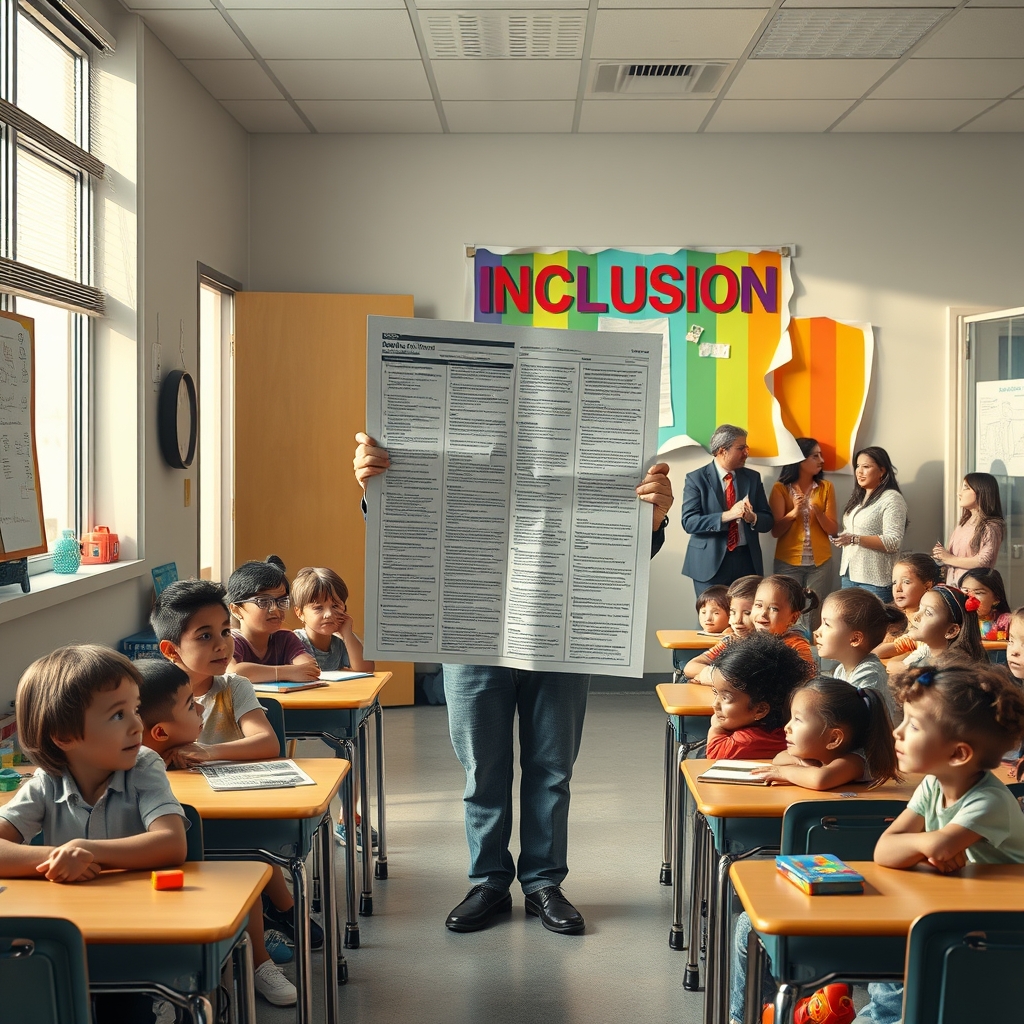
Take, for example, the Individualized Education Plan (IEP), that sacred document hailed as the golden ticket to personalized learning. In theory, it’s a roadmap to success, tailored to each student’s unique needs. In practice? It’s often a bureaucratic nightmare, a 20-page document written in edu-speak so dense even the people who draft it need a translator. Teachers, already drowning in paperwork, are expected to implement these plans with the precision of a Swiss watchmaker, all while managing a classroom of 30 other students who are, conveniently, not the subject of an IEP. Priorities, right?
The Neurodiversity Awareness Industrial Complex
Neurodiversity awareness is the latest darling of the education world, and oh, how we love to virtue-signal about it. Schools host “awareness weeks,” teachers pin rainbow infinity symbols to their lanyards, and administrators give TED Talk-worthy speeches about embracing differences. But let’s be real: awareness without action is just performative allyship. It’s like putting a “Black Lives Matter” sign in your yard while doing nothing to dismantle systemic racism. Cute, but ultimately hollow.
And don’t even get me started on the adaptive learning methods that promise to revolutionize education. These digital panaceas, with their algorithms and data-driven insights, claim to meet every student where they are. But what they often deliver is a one-size-fits-none approach, where students with learning disabilities are funneled into a digital purgatory of endless, soul-crushing drills. Because nothing says “personalized learning” like a computer program that treats a child like a set of data points to be optimized.
The Social-Emotional Learning (SEL) Circus: Where Feelings Become Currency
Enter Social-Emotional Learning (SEL), the educational equivalent of a self-help seminar for kids. Schools have turned emotional intelligence into a curriculum, complete with lesson plans on empathy, resilience, and mindfulness. Because, apparently, children can’t be trusted to develop these skills organically—God forbid they learn to navigate their emotions without a worksheet.
SEL has become so ubiquitous that it’s now a billion-dollar industry, with consultants, programs, and apps all vying for a piece of the emotional education pie. Teachers, already stretched thin, are now expected to be part-time therapists, guiding students through their feelings while simultaneously teaching them long division. Because nothing says “holistic education” like a math lesson interrupted by a group hug and a discussion about “checking in with your emotions.”
The Equity Charade: When Diversity Becomes a Checkbox
Equity in education is the ultimate buzzword, bandied about by administrators and policymakers like a get-out-of-jail-free card. “We’re committed to equity,” they declare, as if saying it three times in a staff meeting will magically erase decades of systemic inequality. But equity isn’t a mission statement or a poster in the hallway—it’s a practice, and one that requires more than lip service.
Schools love to tout their “inclusive classroom design,” which often translates to a few sensory tools in the corner and a “quiet space” that’s really just a repurposed broom closet. Meanwhile, teachers are left to navigate the minefield of differentiated instruction, where they’re expected to tailor lessons to every student’s needs without any additional time, training, or support. It’s like asking a chef to prepare a five-course meal for 30 people with nothing but a microwave and a dream.
The Teacher Professional Development Hamster Wheel
Ah, professional development—the gift that keeps on giving (and by giving, I mean taking). Teachers are herded into workshops and seminars, where they’re lectured about the latest trends in inclusive education, SEL, and adaptive learning. They’re given binders full of strategies they’ll never have time to implement, and then sent back to their classrooms to fend for themselves.
These sessions are often led by consultants who haven’t set foot in a classroom since the Clinton administration, yet somehow know exactly what teachers need to do to “transform” their practice. It’s like hiring a fitness trainer who’s never lifted a weight to teach you how to deadlift. Sure, they’ve read the books, but do they really understand the struggle? Spoiler alert: they don’t.
And let’s not forget the early childhood education industrial complex, where the pressure to “get it right” from day one is so intense it’s a wonder any teacher survives past the first week. The idea that children’s moral and emotional development can be neatly packaged into a curriculum is laughable, yet here we are, treating toddlers like tiny adults who just need the right “character education values” to become model citizens. Because nothing says “childhood” like a lesson plan on integrity.
So here we are, in the grand circus of modern education, where inclusion is the headline act, equity is the sideshow, and teachers are the overworked, underpaid clowns trying to keep the whole thing from imploding. The irony? For all our talk of inclusivity, we’ve created a system that’s anything but. We’ve turned education into a performance, where the goal isn’t to truly meet students’ needs but to convince everyone—parents, policymakers, the general public—that we’re doing just that. And until we stop mistaking buzzwords for progress, the illusion will continue, one rainbow-colored poster at a time.